
 Solitaire Rings
 Halo Rings
 Bezel Rings
 Three Stone Rings
 Five Stone Rings
 Bridal Set Rings
 Solitaire Accent Rings
 Toi Moi Rings
 Curved Rings
 Semi Mount Rings
 Custom Rings
 Color Diamond Rings
 Lab Gemstone Rings
 Men's Rings
 Round
Round
 Pear
Pear
 Oval
Oval
 Princess
 Asscher
 Marquise
 Emerald
 Cushion
 Radiant
 Heart
Heart
 Old Cuts
 Tennis Bracelet
 Fashion Bracelet
 Pendant
 Necklace
 Eternity Bands
 Dainty Bands
 Custom Bands
 Men’s Bands
 Studs
Studs
 Hoops
Hoops
 Jackets
 Dangle
 Bridal
 Pink
Pink
 Champagne
 Yellow
 Blue
Blue
 Black
Black
 Green
Green
 Olive
Olive
 Emerald
 Ruby
Ruby
 Sapphire
 Other Gemstone
 Old Cut Jewelry
 Antique Diamond Jewelry
 Kids Collection
 Celebrity Jewelry
 Round
Round
 Princess
 Asscher
 Cushion
 Radiant
 Emerald
 Heart
Heart
 Pear
Pear
 Oval
Oval
 Marquise
 Old Cut
 Rose Cut
 Pie Cut
 Step Cut
 Portuguese Cut
 Portrait Cut
 Antique Cut
 Matching Pair
 Champagne
 Pink
Pink
 Yellow
 Blue
Blue
 Other
Other
 Emerald
 Ruby
Ruby
 Sapphire
 IGI-GIA Certified
 8X Diamond
 Ready Stocks
 OEC Round
 Ready In Stock
 Old Mine Cushion
 Old Mine Asscher
 Old Mine Emerald
 Old Mine Moval
 Old Mine Pear
 Bands
Bands
 Earrings
 Bracelets
 Necklace
 Anniversary Gift
 Birthday Gift
 Gift For Her
 Gift For Him
 Under 300$
 Under 500$
 Gift Card
 Check Balance
 REVIEW
 +1 (551) 274-2892
 contact@ourosjewels.com
Old European Cut Diamond: From History to the Present Day
Summarize this post with AI

There is something about an old European cut diamond that a modern stone simply cannot replicate. It is not just the sparkle, though the sparkle is extraordinary. It is the weight of history behind it. The knowledge that the stone in your hand was shaped by a craftsman working entirely by hand, without lasers or computer guidance, at a time when fine jewellery was made to last not years but generations.
Old European cut diamonds first appeared around the 1830s and remained the dominant diamond cut in the world for nearly a century. They were worn by Victorian aristocracy and Edwardian society alike, set in gold pendants, threaded onto necklaces, and placed at the centre of engagement rings that are still being worn by their original owners' descendants today.
In recent years, interest in these stones has grown considerably in the UK. Buyers who want something with genuine character, something that does not look like every other ring in a jeweller's window, are increasingly turning to vintage cuts. The old European cut sits at the very top of that list.
In This Guide
- The history of old European cut diamonds
- What exactly makes a diamond 'old European cut'?
- The reasons buyers choose them over modern cuts
- IGI certification and what it means for vintage diamonds
- The key benefits of the cut
- Jewellery styles that suit old European cut diamonds
- Frequently asked questions
- Conclusion
The history of old European cut diamonds
To understand the old European cut, you have to understand the era it came from. Between 1890 and 1935, the period in which this cut was most widely produced, there were no computer-controlled lathes, no laser alignment systems, no digital grading tools. Diamonds were cut by hand, one facet at a time, by craftsmen who had spent years learning their trade.
The result was a diamond that felt deeply personal. Each stone was slightly different from the next. The symmetry was close, but never mechanical. The facets caught the light in a way that shifted as you moved, warmer, deeper, and more romantic than the precise, uniform brilliance of modern stones.
Gemologists generally attribute this cut to European craftsmen, which is where the name originates. It evolved from the Old Mine cut, which preceded it, and in turn laid the groundwork for the round brilliant cut that dominates the market today. Some of the finest old European cut diamonds ever produced came out of workshops in Antwerp, Amsterdam, and London during this period.
In Britain specifically, this was the stone of choice for serious jewellery. Victorian engagement rings, Edwardian brooches, promise rings, heirloom necklaces handed from mother to daughter, and old European cut diamonds ran through all of it. Many of those pieces still exist, and the stones within them are as beautiful today as the day they were cut.
![[History of old European cut diamond]-[ouros jewels]](https://cdn.shopify.com/s/files/1/0527/7669/8040/files/History_of_old_European_cut_diamond_480x480.webp?v=1713185710)
What Is an Old European Cut Diamond?
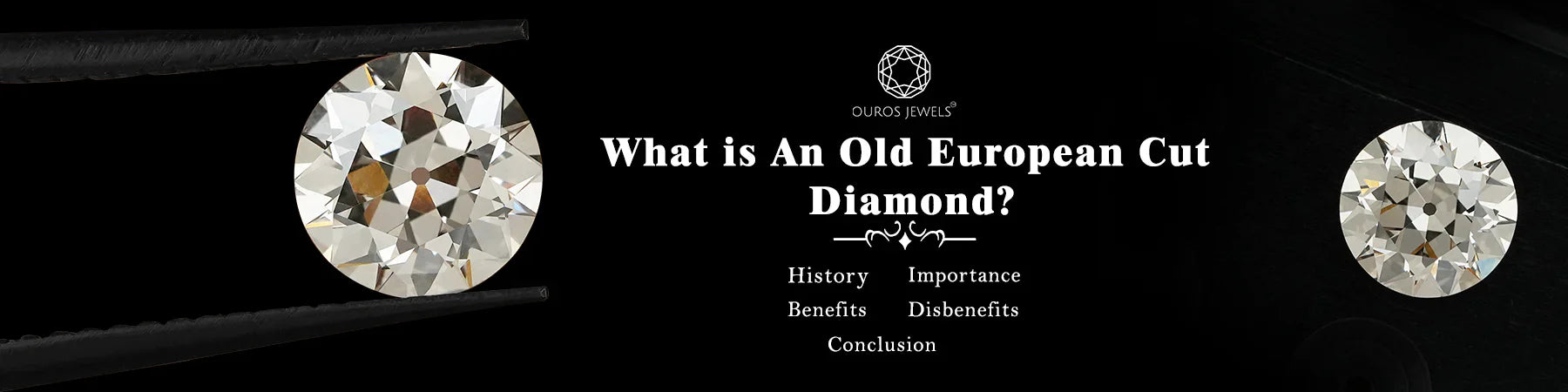
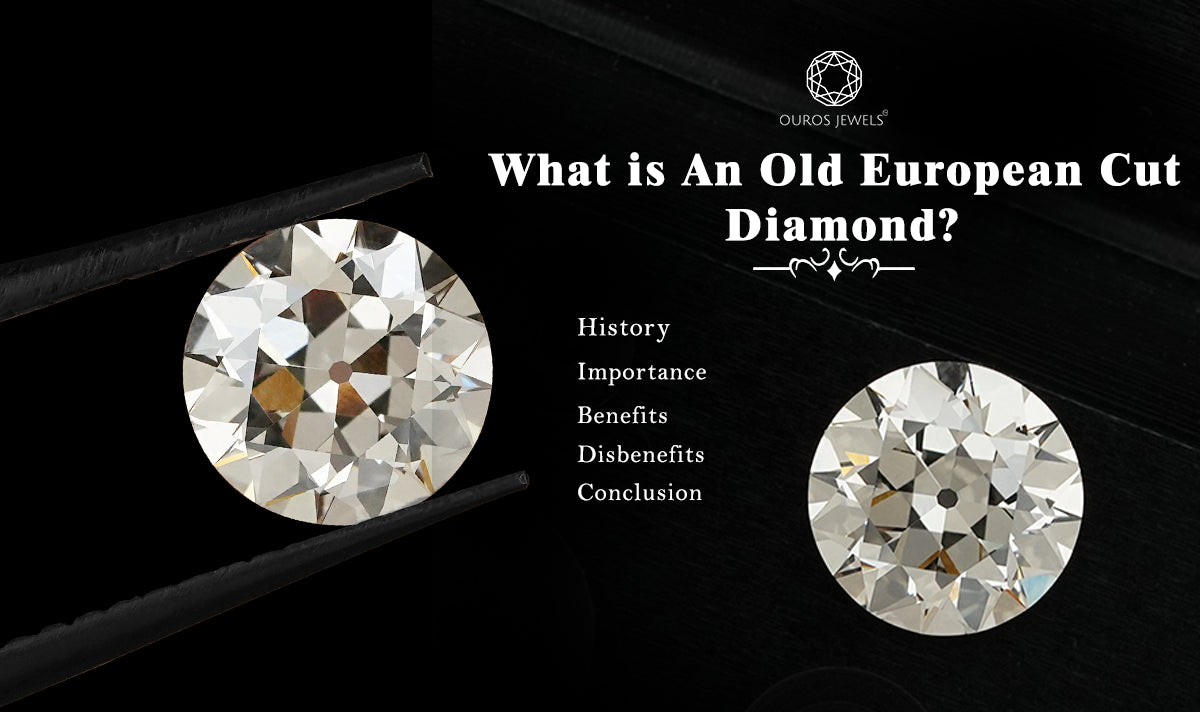
Technically speaking, an old European cut diamond is identified by three specific faceting patterns appearing together on the stones anatomy, round facets, triangular facets, and arrow-shaped facets. When all three are present, typically alongside a visibly open culet and a high crown, you have an old European cut.
In practical terms, here is what that looks like:
- A round outline — most old European cuts are circular in shape
- A high crown — the upper portion of the diamond sits noticeably tall above the girdle
- A small table — the flat top facet is narrower than in modern cuts
- A large culet — the bottom point of the diamond is often flat or open, visible as a small circle when you look straight down through the stone
- 58 facets total — the same number as a modern round brilliant, but arranged in a fundamentally different pattern
The high crown and small table are what give the old European cut its distinctive warmth. Light enters more slowly and bounces at different angles than in a modern stone, producing those larger, slower flashes of colour and white light that collectors and vintage jewellery enthusiasts find so captivating.
Why Do Buyers Choose an Old European Cut Diamond?
Plenty of modern diamond shapes are available. Round brilliant, princess, oval, cushion, all of them are beautifully made and widely loved. So what is it about the old European cut that keeps drawing people back?
The answer is different for everyone, but a few themes come up consistently.
The Sparkle Is Fundamentally Different
A modern round brilliant is engineered to maximise light return, the amount of white light reflected to the eye. It does this extraordinarily well. But old European cut diamonds produce something different: larger, warmer flashes of light, often with more visible colour (what gemologists call 'fire'). The effect is candlelit rather than electric. Many buyers, particularly those who have seen both side by side, find it more emotionally resonant.
The Wide, Square Shaped Table Adds Visual Weight
Old European cut diamonds carry a broader, square-shaped table surface compared with earlier cuts. A wider table creates a larger reflective surface, which means the diamond appears visually generous and bright, the stone commands the hand or the setting in a way that feels unhurried and confident.
![[Old European cut diamond table surface is larger and square]-[ouros jewels]](https://cdn.shopify.com/s/files/1/0527/7669/8040/files/Old_European_diamond_table_surface_480x480.webp?v=1680065135)
The Pavilion Does Something Remarkable with Light
The pavilion, the lower half of the diamond below the girdle, is the engine of its brilliance. In an old European cut, light entering through the crown travels deep into the stone before being reflected upwards through all its visible surfaces. The effect is a richness and depth that is difficult to describe until you see it in person.
The Crown Angle Changes Everything
At 45–50°, the crown facets of an old European cut are steeper than those on most modern diamonds. That angle is what produces the cut's characteristic glow, a slow, warm release of light rather than the immediate, sharp flash of a modern brilliant. It is the difference between a spotlight and a lantern. Both are beautiful. They simply create a different mood.
![[Old European diamond cut's crown facets appearance.]-[ouros jewels]](https://cdn.shopify.com/s/files/1/0527/7669/8040/files/Old_European_diamond_crown_facets_480x480.webp?v=1680066354)
IGI Certification and Old European Cut Diamonds
A question that comes up frequently amongst buyers, particularly those purchasing a vintage or antique stone, is whether old European cut diamonds can be independently certified. The answer is yes.
The International Gemological Institute (IGI) certifies old European cut diamonds against the same grading framework used for modern stones, assessing the 4Cs (cut, colour, clarity, and carat weight), symmetry, proportions, fluorescence, and physical dimensions. An IGI certificate provides an independent, authoritative record of the stone's quality, which matters considerably when you are purchasing a diamond that may be over a century old.
It is worth noting that old European cut diamonds will often receive a lower 'cut' grade on the GIA scale than their modern equivalents, simply because they were not cut to modern round brilliant proportions. This does not diminish the stone, it reflects a different standard, not an inferior one. Many collectors actively seek out IGI-certified old European cut diamonds with lower modern-cut grades because those grades confirm the stone's vintage authenticity.
At Ouros Jewels, all old European cut diamonds are available with full IGI certification.
The Key Benefits of the Old European Cut
For buyers weighing up whether an old European cut is right for them, here are the qualities that set it apart:
- A warm, romantic sparkle that modern cuts are not designed to produce
- Distinctive trio-shaped faceting — no two stones look precisely identical
- A high crown and open culet that lend the stone an unmistakable vintage character
- Naturally lower fluorescence, which preserves the true colour and depth of the stone
- Handcrafted heritage — each stone carries individual character that machine-cut diamonds simply do not have
- Versatility across jewellery styles — equally at home in Art Deco, Victorian, Edwardian, and contemporary vintage-inspired settings
Old European Cut Diamond Jewellery
Part of what makes the old European cut so enduringly appealing is how well it translates across different types of jewellery. This is not a cut that only works in one setting or one style.
Engagement Rings
![[Old round European art deco ring for women.]-[ouros jewels]](https://cdn.shopify.com/s/files/1/0527/7669/8040/files/OEC_Round_Art_Deco_Ring_3_600x600_1_480x480.webp?v=1713178446)
Vintage Wedding Rings
Old European cut vintage rings, particularly those in the 5.80ct total weight range with excellent symmetry grades, make beautifully unconventional wedding rings. The sparkle is different from anything a modern stone can offer: deep, warm, and utterly distinctive. If your aim is a wedding ring that genuinely turns heads, it is difficult to find a more compelling option.
![[Old European cut vintage ring]-[ouros jewels]](https://cdn.shopify.com/s/files/1/0527/7669/8040/files/Old_European_Round_Cut_Black_Coating_Flower_Ring_600x600_1_480x480.webp?v=1713179043)
Earrings
Old European cut diamond earrings work particularly well as a gift, for an anniversary, a significant birthday, or simply as a considered purchase for yourself. Available in stud, drop and dangle, and hoop settings, and across yellow, rose, and white gold in 10ct, 14ct, and 18ct purity, they offer considerable flexibility in terms of both style and budget.
![[Old European diamond earrings for women.]-[ouros jewels]](https://cdn.shopify.com/s/files/1/0527/7669/8040/files/Old_European_diamond_earring_480x480.webp?v=1680069256)
Bracelets
An old European cut diamond bracelet carries the same antique warmth as any other piece in this cut, but in a form that catches the light with every movement of the wrist. Whether you prefer the clean simplicity of a tennis bracelet or a more intricate statement piece, the vintage character of the stones elevates the design considerably. Available in yellow, rose, and white gold from 10ct to 18ct purity.
![[Old European Round Cut Lab Diamond Bracelet]-[ouros jewels]](https://cdn.shopify.com/s/files/1/0527/7669/8040/files/Old_European_Round_Cut_Bracelet_1_540x540_28c298b5-e266-4030-b6bd-817c32d8c809_480x480.webp?v=1713181106)
Necklaces
A tennis necklace set with old European round cut diamonds is one of those pieces that works for almost any occasion, formal, casual, or anywhere in between. The continuous row of warm, vintage-sparkle stones creates something that feels quietly luxurious without being showy. Available in yellow, rose, and white gold from 10ct to 18ct purity.
![[Old European Round Cut Tennis Necklace]-[ouros jewels]](https://cdn.shopify.com/s/files/1/0527/7669/8040/files/Old_European_Necklace_600x600_4f4f14e8-edfe-4101-bff6-cbc733a27f42_480x480.webp?v=1713181476)
Frequently Asked Questions
Q: What is the history of the old European cut diamond?
A: The old European cut was the dominant diamond shape from approximately the 1890s through to the mid-1930s, spanning the late Victorian, Edwardian, and Art Deco periods. Each stone was handcrafted by skilled artisans, predating the mechanical and laser-cutting technology used today. The cut is characterised by a round shape, high crown, small table, and large open culet, producing a deeper, warmer sparkle than contemporary round brilliants.
Q: What is the difference between an old European cut and a modern brilliant cut?
A: The fundamental difference lies in the proportions and the quality of sparkle they produce. Old European cuts have a higher crown, a smaller table, and a larger culet, creating a softer, more romantic glow with larger flashes of colour. Modern round brilliants are precision-engineered to maximise light return, producing a brighter, more uniform sparkle. Neither is objectively superior. They are simply different, and many buyers find the old European cut more emotionally appealing.
Q: What is the oldest diamond cut?
A: The Point Cut, dating to the late Middle Ages, is generally considered the oldest known diamond cut. It retained the natural octahedral form of rough diamonds with minimal intervention and laid the groundwork for everything that followed, including the Old Mine cut and eventually the old European cut.
Q: Are old European cut diamonds IGI certified?
A: Yes. Old European cut diamonds can be independently certified by the International Gemological Institute (IGI), covering the 4Cs, symmetry, proportions, fluorescence, and physical dimensions. At Ouros Jewels, full IGI certification is available on all our old European cut diamonds.
Q: What jewellery suits old European cut diamonds best?
A: They are most at home in vintage and antique-inspired settings, Art Deco engagement rings, Victorian-style necklaces, Edwardian earrings, and heirloom-quality wedding rings. That said, old European cut diamonds can also work beautifully in more contemporary settings for buyers who want a vintage stone in a modern mount.
Q: Why should I choose an old European cut diamond over a modern cut?
A: The honest answer is: it depends on what you want from a diamond. If you want maximum light return and a contemporary look, a modern brilliant is excellent. If you want warmth, history, individual character, and a sparkle that feels genuinely different from anything else on the market, an old European cut is very difficult to beat.
Q: When were old European cut diamonds made?
A: The majority were produced between 1890 and 1935, entirely by hand. This long production window means there is a wide range of quality and character available amongst antique stones, which is one of the reasons independent certification matters so much when purchasing one.
Q: Are old European cut diamonds valuable?
A: Yes, significantly so, both as gemstones and as objects of historical interest. Fine antique stones in original condition frequently command a premium. Lab-grown old European cut diamonds are also available at a more accessible price point, offering the same aesthetic and visual qualities with modern ethical provenance.