Solitaire Rings
 Halo Rings
 Bezel Rings
 Three Stone Rings
 Five Stone Rings
 Bridal Set Rings
 Solitaire Accent Rings
 Toi Moi Rings
 Curved Rings
 Semi Mount Rings
 Custom Rings
 Color Diamond Rings
 Lab Gemstone Rings
 Men's Rings
 Round
Round
 Princess
 Asscher
 Cushion
 Radiant
 Emerald
 Heart
Heart
 Pear
Pear
 Oval
Oval
 Marquise
 Old Mine Cuts
 Eternity Bands
 Dainty Bands
 Custom Bands
 Men’s Bands
 Studs
Studs
 Hoops
Hoops
 Jackets
 Dangle
 Bridal
 Tennis Bracelet
 Fashion Bracelet
 Pendant
 Necklace
 Men's Jewelry
 Pink
Pink
 Champagne
 Yellow
 Blue
Blue
 Black
Black
 Green
Green
 Olive
Olive
 Ruby
Ruby
 Sapphire
 Other Gemstone
 Old Cut Jewelry
 Antique Diamond Jewelry
 Kids Collection
 Celebrity Jewelry
 Old Cut
 Rose Cut
 Pie Cut
 Step Cut
 Portuguese Cut
 Portrait Cut
 Antique Cut
 Matching Pair
 Other
Other
 IGI-GIA Certified
 8X Diamond
 Ready Stocks
 OEC Loose Diamonds
 OEC Rings
 OEC Jewelry
 Old Mine Cushion
 Old Mine Moval
 Old Mine Emerald
 Old Mine Asscher
 Old Mine Pear
 Ready In Stock
 Old Mine Cut Rings
 Old Mine Cut Bands
 Old Mine Cut Earrings
 Old Mine Cut Bracelets
 Old Mine Cut Necklace
 Anniversary Gift
 Birthday Gift
 Gift For Her
 Gift For Him
 Under 300$
 Under 500$
 Gift Card
 Check Balance
 REVIEW
 +1 (551) 274-2892
 contact@ourosjewels.com
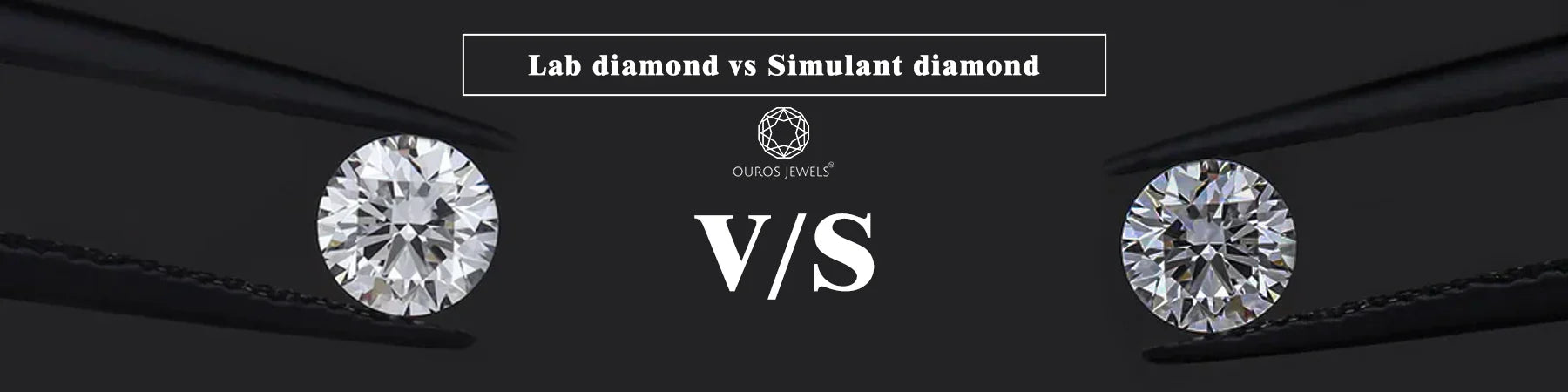
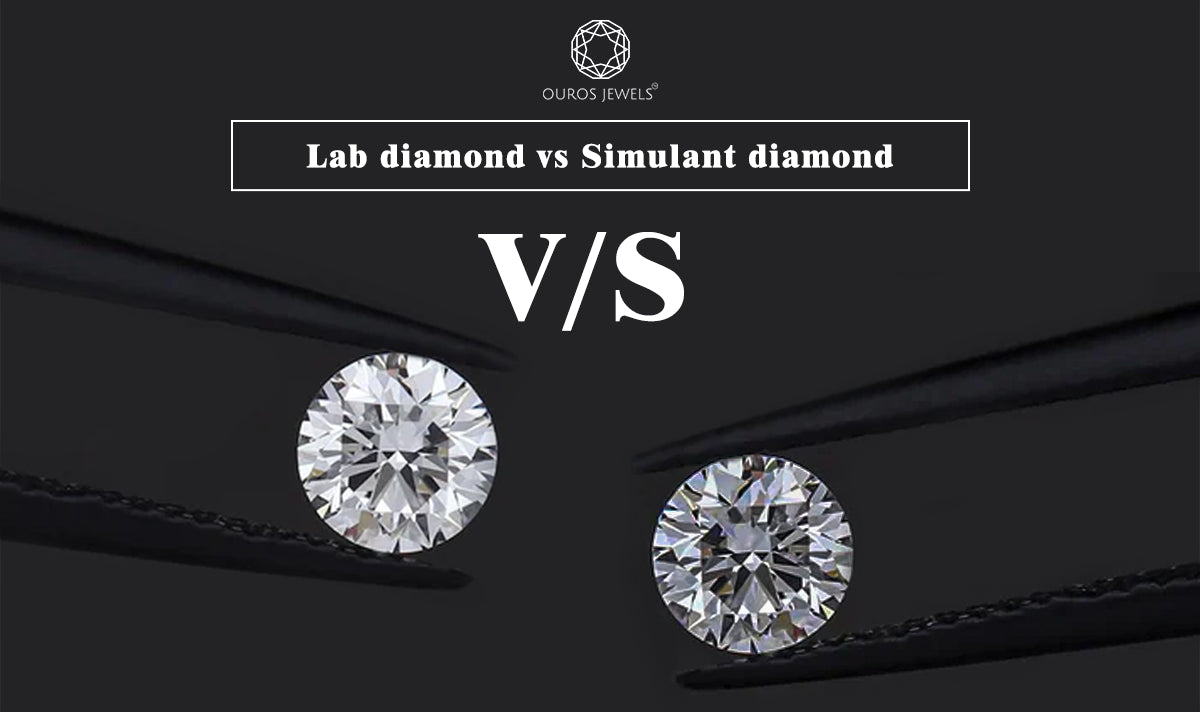
Lab Grown Diamond vs Simulant Diamond: What's the Difference?

Discover the fascinating world of diamond alternatives with this guide to lab grown diamonds, cubic zirconia, and moissanite. Learn the differences in durability, appearance, value, and manufacturing methods that distinguish these stones. Whether you're searching for a sustainable jewellery option, a budget-friendly engagement ring, or simply want to understand diamond alternatives, this guide will help you make an informed decision.
Simulant Diamonds vs Lab Grown Diamonds
Simulant diamonds and lab grown diamonds differ in durability, composition, appearance, and price. Diamond simulants such as cubic zirconia and moissanite are designed to resemble diamonds but are made from different materials. Lab grown diamonds, on the other hand, are real diamonds with the same chemical, physical, and optical properties as mined diamonds.
A. Durability of Simulant and Lab Grown Diamonds
Lab grown diamonds are made from carbon and rank 10 on the Mohs hardness scale, making them the hardest known gemstone material used in jewellery. This exceptional hardness makes them highly resistant to scratching and suitable for everyday wear.
Simulant diamonds have lower hardness ratings:
- Moissanite: 9.25 on the Mohs scale
- Cubic Zirconia: 8 - 8.5 on the Mohs scale
While both are durable enough for jewellery, they are not as hard or scratch-resistant as lab grown diamonds.
B. Sparkle and Light Performance
One of the biggest differences between simulants and lab grown diamonds is how they interact with light.
Lab grown diamonds display the same brilliance, fire, and scintillation as natural diamonds. Their sparkle appears balanced and natural.
Moissanite has a higher refractive index than diamond, producing more colourful flashes of light, often referred to as a "rainbow effect". Many people appreciate this extra sparkle, while others prefer the classic appearance of a diamond.
Cubic zirconia initially appears bright and sparkly but may lose some brilliance over time due to surface wear.
C. Price Comparison
Simulant diamonds are significantly less expensive than lab grown diamonds.
The lower cost of cubic zirconia and moissanite is largely due to:
- Less expensive raw materials
- Faster manufacturing processes
- Lower production costs
Lab grown diamonds require advanced technology, specialised equipment, skilled technicians, cutting, and polishing expertise, contributing to their higher price.
D. Manufacturing Process
Both simulants and lab grown diamonds are created in laboratories, but the materials and processes differ significantly.
Cubic Zirconia is made from zirconium dioxide.
Moissanite is made from silicon carbide.
Lab Grown Diamonds are created from carbon and have the same crystal structure as natural diamonds.
Although lab-grown diamonds are produced in a controlled environment, they are genuine diamonds rather than diamond substitutes.
E. The 4Cs of Diamonds and Simulants
The 4Cs Cut, Colour, Clarity, and Carat Weight are the internationally recognised grading standards for diamonds.
Lab grown diamonds are graded using the same standards as natural diamonds and can receive certification from recognised laboratories.
Moissanite may be assessed using similar characteristics, but it is not graded under the same diamond grading system.
Cubic zirconia is generally not graded using the traditional diamond 4Cs.
F. Symmetry and Faceting
Symmetry refers to the precision and alignment of a gemstone's facets.
Lab grown diamonds can achieve the same symmetry grades as natural diamonds because they are cut using identical techniques.
Moissanite and cubic zirconia can also be cut with excellent symmetry, although their optical properties differ from those of diamonds.
History of Cubic Zirconia
Commercial production of cubic zirconia began in the 1970s. Scientists in the former Soviet Union developed a process for producing gem quality cubic zirconia on a large scale.
Natural cubic zirconia is extremely rare, but laboratory-created cubic zirconia is widely available and has become one of the most popular diamond simulants worldwide.
How Is Cubic Zirconia Made?
Cubic zirconia is produced by melting zirconium dioxide powder at extremely high temperatures.
Once melted, the material crystallises and slowly cools to form rough crystals. These crystals are then cut and polished into finished gemstones.
The manufacturing process allows producers to create cubic zirconia in a wide variety of sizes, shapes, and colours, making it an affordable option for fashion jewellery and engagement ring alternatives.
![[Moissanite appearance differentiate from lab-grown diamond look]-[ouros jewels]](https://cdn.shopify.com/s/files/1/0527/7669/8040/files/DSC00529_480x480.jpg?v=1653740874)
How Is Moissanite Made?
Moissanite is created in a laboratory using silicon carbide.
During production, silicon carbide is exposed to high temperatures and carefully controlled conditions that allow crystals to grow. Once the crystal formation is complete, the rough material is cut and polished into gemstones.
Moissanite is popular because it offers:
- Exceptional brilliance
- Strong durability
- Ethical sourcing
- Affordable pricing
Due to its visual similarity to a diamond, moissanite is often chosen as an alternative engagement ring stone.
One of moissanite's most distinctive characteristics is its intense fire, which produces colourful flashes of light that are often more noticeable than those seen in diamonds.
![[Cubic Zirconia is known as simulant diamonds with its gorgeous appearance]](https://cdn.shopify.com/s/files/1/0527/7669/8040/files/IMG_8570_480x480.jpg?v=1653741930)
How Are Lab Grown Diamonds Made?
Lab-grown diamonds are created using a small diamond seed placed in a controlled environment where carbon atoms bond and form a diamond crystal.
The resulting diamond has the same chemical composition and crystal structure as a mined diamond.
There are two primary methods used to create lab grown diamonds:
1. Chemical Vapour Deposition (CVD)
In the CVD process, a diamond seed is placed inside a chamber filled with carbon rich gases.
The chamber is heated to extremely high temperatures, causing carbon atoms to separate and gradually build layer upon layer on the seed crystal. Over time, this process forms a rough diamond crystal.
Once growth is complete, the rough diamond is cut and polished into a finished gemstone.
2. High Pressure High Temperature (HPHT)
The HPHT process replicates the natural conditions under which diamonds form deep within the Earth.
A diamond seed is placed in a press where extreme heat and pressure are applied. Carbon atoms crystallise around the seed, forming a rough diamond crystal.
After growth, the diamond is cut, polished, and graded in the same way as a mined diamond.
How Does Moissanite Differ from a Lab Grown Diamond?
moissanite vs diamonds in several important ways:
|
Feature |
Lab Grown Diamond |
Moissanite |
|
Composition |
Carbon |
Silicon Carbide |
|
Hardness |
10 Mohs |
9.25 Mohs |
|
Sparkle |
Natural diamond brilliance |
More colourful fire |
|
Authenticity |
Real diamond |
Diamond simulant |
|
Price |
Higher |
Lower |
Moissanite often displays more colourful flashes of light, while lab-grown diamonds offer the traditional appearance associated with natural diamonds.
For buyers seeking the look, feel, and durability of a genuine diamond, lab-grown diamonds are generally the preferred choice.
Which Is Harder: Moissanite or a Diamond?
Lab grown diamonds rank 10 on the Mohs hardness scale.
Moissanite ranks approximately 9.25.
Although moissanite is one of the hardest gemstones available, lab-grown diamonds remain the hardest and most scratch resistant option.
For long-term daily wear, diamonds offer superior durability.
Are Moissanite and Cubic Zirconia Cheaper Than Lab Grown Diamonds?
Yes. Both moissanite and cubic zirconia are generally much more affordable than lab grown diamonds.
As a general comparison:
- Cubic zirconia may cost only a few pounds to a few hundred pounds, depending on size and quality.
- Moissanite typically costs significantly less than an equivalent-sized lab-grown diamond.
- Lab grown diamonds are more expensive because they are genuine diamonds and require advanced technology to produce.
For example, a 1 carat cubic zirconia or moissanite stone may cost substantially less than a 1 carat lab grown diamond of comparable appearance.
If budget is the primary concern, simulants can be an attractive choice. If durability, authenticity, and long term value are important, a lab grown diamond is often considered the better investment.
Conclusion
Lab grown diamonds, moissanite, and cubic zirconia each offer unique advantages for modern jewellery buyers.
Lab grown diamonds are real diamonds that provide exceptional durability, authenticity, and the same beauty as mined diamonds while offering a more sustainable and often more affordable alternative.
Moissanite is valued for its outstanding brilliance, ethical production, and lower cost.
Cubic zirconia remains one of the most budget friendly diamond alternative available.
The right choice depends on your priorities, whether that is authenticity, sparkle, durability, sustainability, or affordability. Understanding the differences between these gemstones can help you select the perfect stone for your engagement ring, wedding jewellery, or everyday collection.
FAQs
What is the difference between a lab grown diamond and a simulant diamond?
Lab grown diamonds are real diamonds created in a laboratory and have the same physical, chemical, and optical properties as mined diamonds. Simulants such as moissanite and cubic zirconia resemble diamonds but are made from different materials.
Is moissanite better than a lab grown diamond?
Neither is objectively better. Moissanite is more affordable and offers exceptional sparkle, while lab grown diamonds provide the authenticity, durability, and appearance of a genuine diamond.
How are cubic zirconia and moissanite manufactured?
Cubic zirconia is created by melting zirconium dioxide at extremely high temperatures. Moissanite is produced by growing silicon carbide crystals in a controlled laboratory environment.
Can jewellers tell the difference between moissanite and lab grown diamonds?
Yes. Professional jewellers use specialised equipment to identify differences in composition, thermal conductivity, and optical properties.
Why do moissanite and cubic zirconia cost less than lab grown diamonds?
They are less expensive to manufacture and use different raw materials. Lab grown diamonds require advanced diamond growing technology and are genuine diamonds, which contributes to their higher value.
Do lab grown diamonds test as real diamonds?
Yes. Lab grown diamonds have the same chemical composition as mined diamonds and typically test positive on standard diamond testers.
Which stone is best for an engagement ring?
Lab grown diamonds are often preferred for engagement rings because they offer genuine diamond beauty and durability. However, moissanite is a popular alternative for buyers seeking maximum sparkle at a lower price point.
Does cubic zirconia lose its sparkle over time?
Cubic zirconia can become scratched and may lose some brilliance with regular wear, whereas diamonds and moissanite generally maintain their appearance for much longer.
Shop Lab diamond jewelry