


 Engagement Ring Sale
 Hoop Earring Sale
 Solitaire Rings
 Halo Rings
 Bezel Rings
 Three Stone Rings
 Five Stone Rings
 Bridal Set Rings
 Solitaire Accent Rings
 Toi Moi Rings
 Curved Rings
 Semi Mount Rings
 Custom Rings
 Color Diamond Rings
 Lab Gemstone Rings
 Men's Rings
 Round
Round
 Princess
 Asscher
 Cushion
 Radiant
 Emerald
 Heart
Heart
 Pear
Pear
 Oval
Oval
 Marquise
 Old Mine Cuts
 Eternity Bands
 Dainty Bands
 Custom Bands
 Men’s Bands
 Studs
Studs
 Hoops
Hoops
 Jackets
 Dangle
 Bridal
 Tennis Bracelet
 Fashion Bracelet
 Pendant
 Necklace
 Men's Jewelry
 Pink
Pink
 Champagne
 Yellow
 Blue
Blue
 Black
Black
 Green
Green
 Olive
Olive
 Ruby
Ruby
 Sapphire
 Other Gemstone
 Old Cut Jewelry
 Antique Diamond Jewelry
 Kids Collection
 Celebrity Jewelry
 Old Cut
 Rose Cut
 Pie Cut
 Step Cut
 Portuguese Cut
 Portrait Cut
 Antique Cut
 Matching Pair
 Other
Other
 IGI-GIA Certified
 8X Diamond
 Ready Stocks
 OEC Loose Diamonds
 OEC Rings
 OEC Jewelry
 Old Mine Cushion
 Old Mine Moval
 Old Mine Emerald
 Old Mine Asscher
 Old Mine Pear
 Ready In Stock
 Old Mine Cut Rings
 Old Mine Cut Bands
 Old Mine Cut Earrings
 Old Mine Cut Bracelets
 Old Mine Cut Necklace
 Anniversary Gift
 Birthday Gift
 Gift For Her
 Gift For Him
 Under 300$
 Under 500$
 Gift Card
 Check Balance
 REVIEW
 +1 (551) 274-2892
 contact@ourosjewels.com

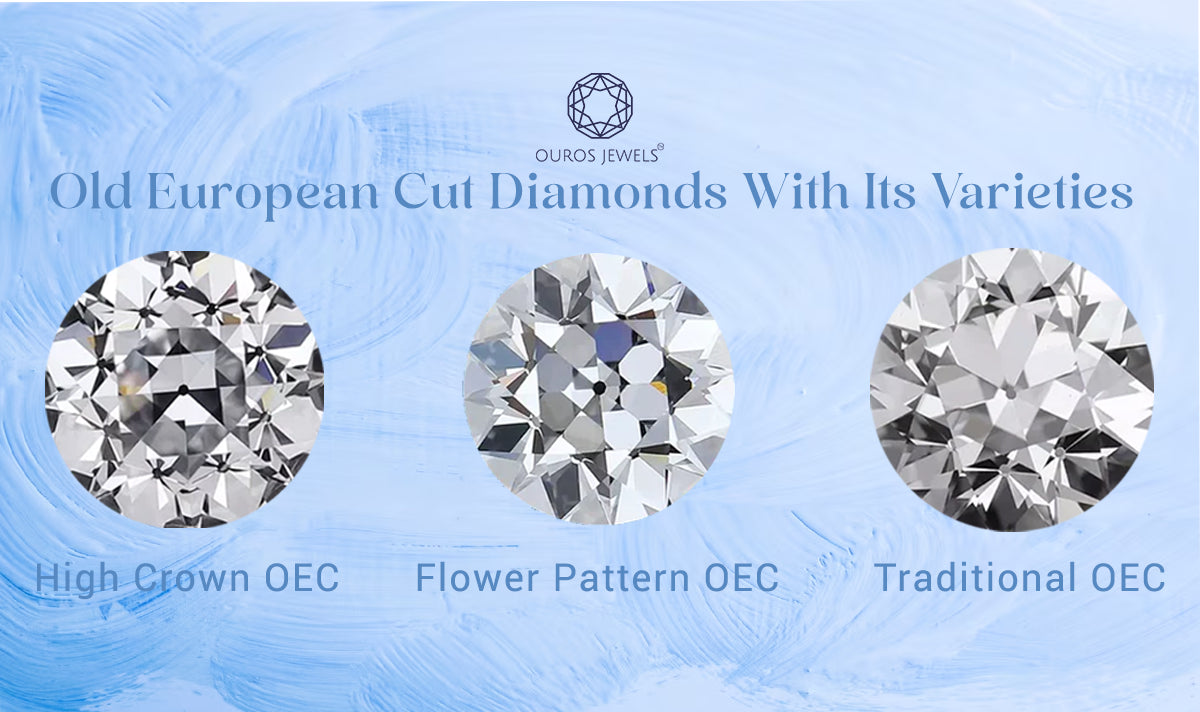
Old European Cut Diamond Varieties and Their Differences

Old European Cut (OEC) diamonds are representatives of an earlier era of diamond craftsmanship and are valued for their distinctive vintage appearance and unique faceting. They were developed before modern brilliant cut techniques became standard, and their faceting pattern differs considerably from that of contemporary brilliant-cut diamonds. This distinctive structure makes Old European Cut diamonds recognisable by their appearance and light performance.
Today, there are several variations of Old European Cut diamonds, each offering a different combination of proportions, faceting and visual character. In this guide, we focus on three OEC patterns: High Crown Pattern, Flower Pattern and Traditional Pattern.
Many people assume that Old European Cut diamonds have limited variety or may lack durability because of their antique-inspired proportions. However, the reality is more nuanced. Their appearance, proportions and craftsmanship can vary considerably, making each stone different.
At Ouros Jewels, these variations are crafted with carefully considered proportions to offer customers more choice when selecting an Old European style diamond.
Before choosing between these three patterns, it is useful to understand the defining characteristics of each one.
High Crown Pattern Old European Diamond
The High Crown Pattern Old European Diamond is recognised for its elevated crown and distinctive faceting arrangement. Its faceting style gives it a more elaborate appearance compared with some traditional OEC designs.
The crown contains star and triangular shaped facets that interact with light to create flashes of sparkle and reflection. The combination of a smaller table, higher crown and deeper proportions contributes to its characteristic vintage appearance.
For example, the High Crown Old European diamond available from Ouros Jewels is designed with a high crown and carefully arranged facets:
![[High crown pattern old European diamond]-[ouros jewels]](https://cdn.shopify.com/s/files/1/0527/7669/8040/files/old_european_cut_diamond_f69099fb-09de-4697-88f4-d56dcdb739fa_480x480.webp?v=1712903407)
High Crown Old European Diamond
A high-crown OEC can have a distinctive visual structure across the table and crown, with a more pronounced crown profile than a conventional modern round brilliant. The relationship between the crown, table and girdle contributes significantly to its overall appearance.
Some High Crown OEC designs also feature intricate facet arrangements that require precise cutting and polishing. Skilled craftsmanship is particularly important when working with these proportions because the facet relationships need to remain balanced to produce an attractive light pattern.
For buyers interested in vintage inspired jewellery, the High Crown pattern can offer a distinctive alternative to a modern round brilliant.
![[Old European Round Cut Art Deco Halo Engagement Ring]-[ouros jewels]](https://cdn.shopify.com/s/files/1/0527/7669/8040/files/OEC_Round_Art_Deco_Ring_3_600x600_ff130316-fcac-4b7c-87d4-5c95c96e8e7e_480x480.webp?v=1712903537)
Flower Pattern Old European Diamond
The Flower Pattern Old European Diamond is another distinctive variation. Its name comes from the floral appearance created by the arrangement of facets across the crown and table.
In this style, the crown facets combine triangular and rounded shapes, creating a pattern that can resemble the petals of a flower. This arrangement affects how light travels through the stone and can produce a softer, more dispersed visual effect.
A square-like framework can also be visible across the table, contributing to the floral decoration and antique character of the diamond.
![[Unique-Flower-Pattern-Round-Cut-Lab-Grown-Diamond_]-[ouros jewels]](https://cdn.shopify.com/s/files/1/0527/7669/8040/files/Unique-Flower-Pattern-Round-Cut-Lab-Grown-Diamond_600x600_a95fd3b1-7e5b-4474-93d3-a635e46abe0d_480x480.webp?v=1712903294)
Flower Pattern Old European Cut
The Flower Pattern OEC shown by Ouros Jewels is offered in VS clarity and F colour. VS clarity can be a practical choice for buyers who want a balance between visible diamond quality and value, although the appearance of inclusions should always be considered on an individual stone-by-stone basis.
The floral facet arrangement gives this style its own identity. Rather than trying to replicate the uniform brilliance of a modern round brilliant, the Flower Pattern OEC is valued for its distinctive pattern and vintage-inspired light performance.
Difference Between High Crown and Flower Pattern Old European Diamonds
The primary difference between the High Crown Pattern OEC and Flower Pattern OEC is their facet arrangement and resulting visual appearance.
In the Flower Pattern Old European Cut diamond, the crown facets can create a petal- or mountain-like visual pattern. The floral arrangement is particularly noticeable when viewing the diamond from above.
The High Crown OEC, by comparison, places greater emphasis on its elevated crown and more structured facet arrangement. Depending on the individual stone, the facets may create geometric patterns that can resemble a chessboard or other structured designs.
The Flower Pattern can sometimes produce a softer or slightly hazier visual effect, which is part of the character some buyers associate with antique-style diamonds. This appearance should not automatically be interpreted as a defect, as OEC diamonds are often selected specifically for their distinctive light performance rather than the highly uniform brilliance of a modern round brilliant.
The proportions and dimensions of the Flower Pattern also influence how the available space across the crown and table is used, contributing to its recognisable floral appearance.
Traditional Old European Diamond
The Traditional Old European Diamond represents the classic OEC style in this three-pattern classification. Its faceting combines geometric and vintage-inspired elements while maintaining the characteristic proportions associated with Old European-style cutting.
The Traditional OEC can feature chessboard-like and mountain-line faceting patterns arranged according to the proportions of the individual diamond.

Traditional Old European Cut Diamond
The Traditional OEC shown by Ouros Jewels is available in VS2 clarity and F colour. VS2 can be suitable for an engagement ring or antique-inspired necklace when the individual stone has good visual clarity. As with all clarity grades, the actual appearance of inclusions depends on the particular diamond.
Traditional OEC diamonds can also combine characteristics associated with High Crown and Flower Pattern designs. This gives buyers an option between the more distinctive specialised patterns and a more classic Old European appearance.
One important point is that Old European Cut diamonds should still be evaluated using the same fundamental diamond quality considerations, including the 4Cs—colour, clarity, cut and carat weight—along with proportions, symmetry, polish and the overall visual appearance of the individual stone.
For antique-inspired engagement rings and other jewellery, the Traditional OEC can therefore provide a balance between historical character and contemporary jewellery requirements.
High Crown OEC vs Flower Pattern OEC vs Traditional OEC
|
Differentiation Point |
High Crown OEC |
Flower Pattern OEC |
Traditional OEC |
|
Facet Design |
Features a structured, geometric faceting arrangement associated with its high crown and distinctive OEC appearance. |
Features floral-style faceting across the table and crown, creating a petal-like pattern. |
Combines classic Old European-style facets with elements that may overlap with High Crown and Flower Pattern designs. |
|
Defining Feature |
A pronounced crown and distinctive crown-to-table proportions are central to the design. |
Floral or sunflower-like facet arrangements give the diamond its characteristic appearance. |
A classic OEC appearance with traditional proportions and vintage-inspired facet patterns. |
|
Appearance |
Often appears classic and vintage, with structured reflections and less of the floral appearance associated with Flower Pattern OECs. |
Can display a softer or more dispersed appearance because of its floral-style faceting. |
Offers a traditional antique-inspired appearance with a combination of geometric and softer light patterns. |
|
Colour Preference |
Colour preference depends on the individual stone and buyer's taste; warmer colours can complement its vintage character. |
Colour choice can influence the overall softness and warmth of the stone's appearance. |
Available across different colour grades, allowing buyers to select according to their preferred balance of colour and value. |
|
Cut Considerations |
Proportions, crown height, table size, symmetry and facet alignment are particularly important. |
Facet arrangement, proportions and symmetry influence the floral pattern and light performance. |
Proportions and facet symmetry should be assessed together with the overall appearance of the individual diamond. |
|
4Cs |
Evaluated using carat, colour, clarity and cut, alongside proportions and visual appearance. |
Evaluated using the same 4Cs, with additional attention to its distinctive floral faceting. |
Evaluated using the same 4Cs, proportions, symmetry and overall vintage appearance. |
Which Old European Cut Diamond Is Right for You?
Choosing between the three patterns ultimately depends on the appearance and character you want from your diamond.
- Choose a High Crown OEC if you prefer a more pronounced crown and structured, geometric facet pattern.
- Choose a Flower Pattern OEC if you are attracted to floral-style faceting and a softer, more distinctive appearance.
- Choose a Traditional OEC if you prefer a classic Old European appearance that incorporates traditional vintage inspired faceting.
It is also important to remember that two diamonds with the same shape, carat weight, colour and clarity can still look different because of variations in proportions, facet arrangement, symmetry and cutting quality.
For this reason, buyers should consider the individual diamond's visual appearance, rather than relying only on a single cut description or grading characteristic.
Conclusion
Old European Cut diamonds bring together the beauty of historical diamond craftsmanship and a distinctive form of light performance. Whether you prefer the intricate High Crown, the nature-inspired Flower Pattern, or the classic Traditional OEC, each style offers its own visual character.
Unlike modern round brilliant diamonds, Old European Cuts are appreciated for their antique proportions, individual faceting and unique personality. Their charm comes from the way these characteristics interact rather than from trying to reproduce the exact brilliance pattern of a contemporary brilliant cut.
At Ouros Jewels, buyers can explore different Old European-style diamond variations and choose a design that suits their preferred appearance and jewellery style.
Selecting an Old European Cut diamond is ultimately about choosing character, individuality and a connection to an earlier era of diamond craftsmanship.
FAQs About Old European Cut Diamonds
Q1. What is the difference between an Old European Cut and an Old Mine Cut?
The main difference between Old Mine Cut and Old European Cut diamonds is their shape and faceting development. Old Mine Cuts are generally associated with a squarer or cushion-like outline and are known for their distinctive antique appearance. Old European Cuts typically have a round outline and were developed with more regularised faceting.
Both cuts have vintage character, but Old Mine Cuts are often chosen for their distinctive outline, while Old European Cuts are recognised for their round shape, high crown and characteristic antique-style sparkle.
Q2. Are Old European Cut diamonds good?
Yes. Old European Cut diamonds can be an excellent choice for buyers who appreciate vintage character and distinctive light performance.
They may not produce the same type of uniform, intense brilliance as a modern round brilliant diamond, but their larger facets, high crowns and antique proportions can create broader flashes and a softer visual effect. Their value depends on factors such as carat weight, colour, clarity, proportions, craftsmanship, rarity and market demand.
Q3. Why choose an Old European Cut diamond?
An Old European Cut diamond can be a good choice if you want a stone with historical character and a distinctive appearance.
Its high crown, deep pavilion and large culet are among the features traditionally associated with the cut. These proportions contribute to its recognisable vintage appearance and unique interaction with light.
Q4. Which cut grade do Old European Cut diamonds receive?
Cut grading for Old European Cut diamonds can vary depending on the grading laboratory and the individual stone. Modern grading systems are primarily designed around contemporary diamond cuts, so antique and old-style diamonds may not always receive the same type of cut-grade assessment as a modern round brilliant.
For this reason, buyers should look beyond a single cut-grade label and consider the diamond's proportions, symmetry, polish, facet pattern and overall visual appearance.
Q5. Are old-cut diamonds good?
Old-cut diamonds can be an excellent choice for people who appreciate vintage jewellery and a softer, more individual form of brilliance.
Their appeal is not necessarily based on achieving the maximum brilliance of a modern brilliant cut. Instead, old-cut diamonds are valued for their character, historical inspiration, broader facets and distinctive light patterns.
Q6. What does Old European Cut diamond mean?
An Old European Cut diamond is a historic round diamond-cutting style that developed before modern diamond-cutting techniques became standard.
It is commonly characterised by a round outline, relatively high crown, deep pavilion, smaller table and larger culet. These characteristics give the diamond its distinctive antique appearance and unique pattern of light reflection.
Q7. What's the difference between an Old European Cut and an Old Mine Cut?
The Old European Cut developed after the Old Mine Cut and generally has a more rounded outline and more regularised faceting.
Old Mine Cuts are commonly associated with cushion-like or squarer outlines, while Old European Cuts are usually rounder and have a higher crown and smaller table. Both cuts are associated with antique jewellery and can display a softer, broader type of sparkle than many modern brilliant cuts.
Q8. Are Old Cut diamonds cheaper?
Not necessarily. Old Cut diamonds can sometimes be less expensive than comparable modern brilliant cuts, but this is not guaranteed.
Prices vary according to the diamond carat weight, colour, clarity, proportions, condition, craftsmanship, rarity and market demand. Particularly unusual or well-preserved antique diamonds can command a premium because of their rarity and historical character.
Q9. Are Old European Cut diamonds durable?
An Old European Cut diamond is still a diamond and has the same fundamental hardness as other diamond cuts. However, its antique-style proportions and larger culet or facet structure can differ from modern cuts.
Durability depends on the individual stone, including its girdle condition, inclusions, proportions and any existing chips or damage. For an engagement ring or frequently worn jewellery, the diamond should be assessed individually and set appropriately for everyday wear.
Q10. How should I choose an Old European Cut diamond?
Start by considering the diamond overall appearance rather than relying solely on its colour, clarity or cut label. Look at the proportions, facet pattern, symmetry, polish, culet, crown and visual response to light.
Then compare the three OEC patterns to determine whether you prefer the structured appearance of a High Crown, the floral pattern of a Flower OEC, or the classic character of a Traditional OEC.
The best choice is ultimately the diamond whose pattern, proportions and appearance match your personal taste and jewellery design.


