


 Eternity Wedding Bands Sale
 Gemstone Jewelry Sale
 Solitaire Rings
 Halo Rings
 Bezel Rings
 Three Stone Rings
 Five Stone Rings
 Bridal Set Rings
 Solitaire Accent Rings
 Toi Moi Rings
 Curved Rings
 Semi Mount Rings
 Custom Rings
 Color Diamond Rings
 Lab Gemstone Rings
 Men's Rings
 Round
Round
 Princess
 Asscher
 Cushion
 Radiant
 Emerald
 Heart
Heart
 Pear
Pear
 Oval
Oval
 Marquise
 Old Mine Cuts
 Eternity Bands
 Dainty Bands
 Custom Bands
 Men’s Bands
 Studs
Studs
 Hoops
Hoops
 Jackets
 Dangle
 Bridal
 Tennis Bracelet
 Fashion Bracelet
 Pendant
 Necklace
 Men's Jewelry
 Pink
Pink
 Champagne
 Yellow
 Blue
Blue
 Black
Black
 Green
Green
 Olive
Olive
 Ruby
Ruby
 Sapphire
 Other Gemstone
 Old Cut Jewelry
 Antique Diamond Jewelry
 Kids Collection
 Celebrity Jewelry
 Old Cut
 Rose Cut
 Pie Cut
 Step Cut
 Portuguese Cut
 Portrait Cut
 Antique Cut
 Matching Pair
 Other
Other
 IGI-GIA Certified
 8X Diamond
 Ready Stocks
 OEC Loose Diamonds
 OEC Rings
 OEC Jewelry
 Old Mine Cushion
 Old Mine Moval
 Old Mine Emerald
 Old Mine Asscher
 Old Mine Pear
 Ready In Stock
 Old Mine Cut Rings
 Old Mine Cut Bands
 Old Mine Cut Earrings
 Old Mine Cut Bracelets
 Old Mine Cut Necklace
 Anniversary Gift
 Birthday Gift
 Gift For Her
 Gift For Him
 Under 300$
 Under 500$
 Gift Card
 Check Balance
 REVIEW
 +1 (551) 274-2892
 contact@ourosjewels.com

What Is Diamond Symmetry? A Detailed Guide

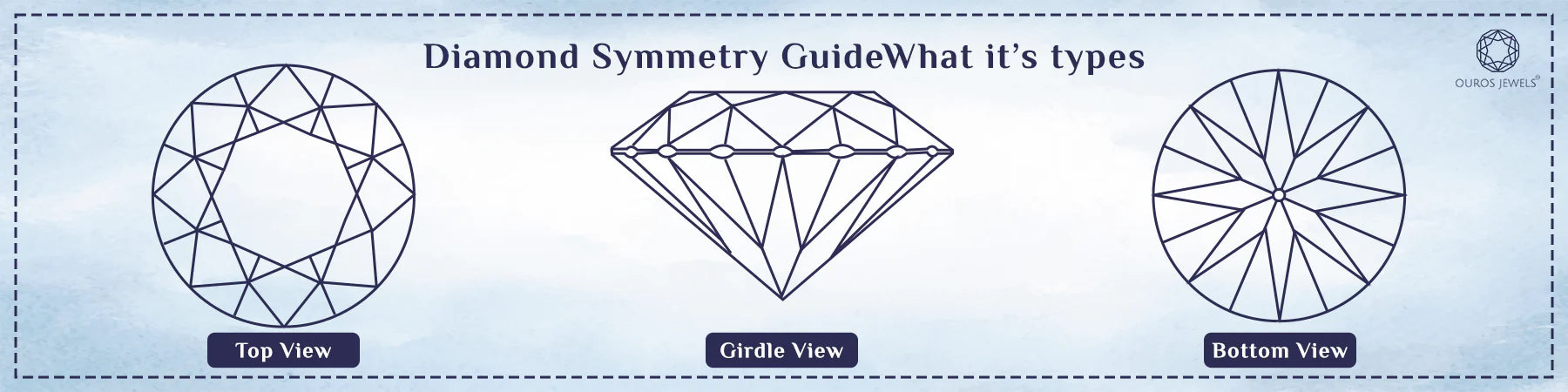
Diamond symmetry refers to the precision of a diamond overall shape and the arrangement, placement and alignment of its facets. When viewed from different angles, the facets should form a balanced and consistent pattern.
Symmetry is an important part of a diamond craftsmanship because facet alignment can influence how evenly the stone displays brightness, fire and scintillation. In a well-made round brilliant diamond, for example, the facets should align consistently around the stone, creating a balanced visual pattern.
When you look at a diamond pavilion, you may see structured facet patterns, including the familiar arrow like pattern associated with optical symmetry in some round brilliant diamonds. However, the presence of an arrow pattern alone does not determine a diamond overall symmetry or cut quality.
Understanding diamond symmetry can help when comparing loose diamonds or diamond jewellery. Symmetry is normally reported separately on a diamond grading report and is graded from Excellent to Poor.
Let's explore the meaning of diamond symmetry, the difference between diamond cut and symmetry, why symmetry matters, and the different symmetry grades.
What Is Diamond Symmetry?
Diamond symmetry represents the precision of a diamond shape and the arrangement of its facets. It considers whether the facets are correctly positioned, aligned and matched in relation to one another.
According to GIA, symmetry evaluates the exactness of a diamond outline and the shape, placement and alignment of its facets.
For a round brilliant diamond, good symmetry means that corresponding facets are positioned consistently around the stone. The table should be properly centred, the pavilion facets should meet correctly at the culet, and the overall outline should appear balanced.
Diamond symmetry can contribute to consistent light performance, but it is important to remember that symmetry is only one part of a diamond overall cut quality. Proportions, polish, brightness, fire, scintillation, weight ratio and durability also contribute to the final cut assessment.
Difference Between Diamond Cut and Symmetry Grade
The main difference between diamond cut and symmetry is what each term evaluates.
Diamond cut is a broader assessment of how well a diamond has been designed, proportioned, faceted and finished, and how effectively it interacts with light. For standard round brilliant diamonds, GIA considers seven components when determining cut quality: brightness, fire, scintillation, weight ratio, durability, polish and symmetry.
Symmetry, on the other hand, specifically evaluates the accuracy of the diamond outline and the placement and alignment of its facets.
|
Diamond Cut |
Diamond Symmetry |
|
A broader assessment of design, proportions and craftsmanship |
Focuses specifically on shape and facet alignment |
|
Considers light performance, proportions, durability, polish and symmetry |
Evaluates the exactness of the outline and facet arrangement |
|
For standard round brilliant diamonds, graded from Excellent to Poor by GIA |
Also graded from Excellent to Poor |
|
Helps describe how effectively the diamond interacts with light |
Helps assess the precision of the diamond's construction |
Therefore, it is not accurate to say that symmetry is simply "more important" than cut. Symmetry contributes to cut quality, and the two should be considered together when evaluating a diamond.
The Importance of Diamond Symmetry
Diamond symmetry can contribute to the way a stone displays light and its overall visual balance. The arrangement of the facets works together with the diamond's proportions and polish to influence its brightness, fire and scintillation.
Let's look at why diamond symmetry is an important consideration when assessing a diamond.
It Helps Create Balanced Sparkle and Light Reflection
The arrangement and alignment of a diamond facets influence its visual pattern and light performance.
When the facets are properly aligned, a diamond can show a more even distribution of brightness and scintillation. GIA notes that a symmetrical diamond can display an even pattern of brightness, fire and scintillation, while poor symmetry can contribute to weaker light performance.
This is particularly relevant when choosing diamonds for engagement rings, wedding rings, necklaces, earrings and other jewellery, where the stone's face-up appearance is an important consideration.
It Contributes to the Diamond Overall Facet Arrangement
A diamond contains several anatomical sections, including the table, crown, girdle, pavilion and culet. Symmetry considers how accurately these elements and their facets are positioned in relation to one another.
For example, symmetry grading can identify features such as facet misalignment, a wavy girdle, variation in girdle thickness, or a table and girdle that are not properly parallel. These are among the features considered when assessing diamond symmetry.
A well aligned facet arrangement can help create a more balanced appearance, while noticeable symmetry deviations may affect the stone's visual consistency.
After understanding why symmetry matters, let's look at the different diamond symmetry grades.
What Are Diamond Symmetry Grades?
Diamond symmetry is commonly graded on a five-point scale:
Excellent, Very Good, Good, Fair and Poor.
These grades describe the accuracy of the diamond outline and the placement and alignment of its facets. GIA assesses symmetry visually and considers a range of proportion related and facet-related symmetry features.
|
Symmetry Grade |
What It Indicates |
|
1. Excellent Symmetry |
The diamond has a highly precise outline and very accurate facet placement and alignment. |
|
2. Very Good Symmetry |
The diamond has strong overall symmetry with only minor deviations from ideal alignment. |
|
3. Good Symmetry |
The diamond has noticeable but generally limited symmetry deviations. |
|
4. Fair Symmetry |
The diamond has more apparent inconsistencies in its outline or facet arrangement. |
|
5. Poor Symmetry |
The diamond has significant symmetry deviations that can affect its overall appearance and potentially its light performance. |
These grades should be considered alongside the diamond's cut, proportions and polish rather than used on their own to judge overall quality.
Excellent Symmetry Graded Diamonds
![[Excellent symmetry grade diamonds]-[ouros jewels]](https://cdn.shopify.com/s/files/1/0527/7669/8040/files/Blog-Diamond_Symmetry-Excellent_Symmetry-Ouros_Jewels_42a896f7-dc77-40d0-954e-90a4fddaaadf_480x480.webp?v=1684832445)
An Excellent symmetry grade indicates a high level of precision in the diamond outline and facet arrangement. In a round brilliant diamond, for example, the corresponding facets should align consistently around the stone, with the table properly centred and the pavilion facets meeting correctly at the culet.
Round brilliant diamonds are particularly useful for understanding symmetry because their facet arrangement is designed around a regular, repeating pattern.
Excellent symmetry can contribute to a balanced visual appearance and consistent light performance. However, it should still be considered alongside cut grade, proportions, polish and the diamond's other characteristics.
For engagement rings and other diamond jewellery, an Excellent symmetry grade can be a useful quality indicator when comparing otherwise similar stones.
Very Good Symmetry Grade Diamonds
![[Very good symmetry diamonds]-[ouros jewels]](https://cdn.shopify.com/s/files/1/0527/7669/8040/files/Blog-Diamond_Symmetry-Very_Good_Symmetry-Ouros_Jewels_7a233056-0d18-4e35-898c-8a47f58bef56_480x480.webp?v=1684832468)
A Very Good symmetry grade means that the diamond has a strong overall facet arrangement, although there may be minor deviations from the precision seen in an Excellent symmetry grade.
These differences can involve small variations in facet alignment or the diamond's outline that are visible during professional grading but may have little noticeable effect on the diamond appearance.
A Very Good symmetry grade can therefore be a practical consideration when comparing diamonds for pendants, necklaces, engagement rings or other jewellery, particularly when the stone offers a favourable combination of cut, proportions, colour, clarity and carat weight.
Good Symmetry Grade Diamond
![[Good symmetry grade diamond]-[ouros jewels]](https://cdn.shopify.com/s/files/1/0527/7669/8040/files/Blog-Diamond_Symmetry-Good_Symmetry-Ouros_Jewels_4a1a1285-ef68-45b1-915d-d4add6945be9_480x480.webp?v=1684832499)
A Good symmetry grade indicates that more noticeable deviations are present in the diamond shape or facet alignment.
The facets may not align as precisely as they would in an Excellent or Very Good symmetry diamond. Depending on the severity and location of the symmetry features, this can influence the consistency of the stone's visual pattern and light performance.
However, symmetry should not be assessed in isolation. A diamond's overall appearance results from the interaction of its proportions, facet arrangement, polish and other cut characteristics.
For this reason, a Good symmetry grade does not automatically mean that a diamond will look dull or unattractive. The complete grading report and the diamond itself should be considered.
Fair Symmetry Grade Diamonds
![[Fair symmetry grade diamond]-[ouros jewels]](https://cdn.shopify.com/s/files/1/0527/7669/8040/files/Blog-Diamond_Symmetry-Fair_Symmetry-Ouros_Jewels_28f0d62d-461d-44dd-b5a8-913727556374_480x480.webp?v=1684832524)
Fair symmetry indicates more noticeable inconsistencies in the diamond's outline or facet arrangement.
At this level, facet alignment may be less consistent, and the diamond can show a less balanced pattern when viewed face-up or from different angles.
Because symmetry works together with other cut characteristics, the effect on appearance can vary from one diamond to another. Buyers considering a Fair symmetry diamond should pay particular attention to the stone's overall cut quality and visual appearance rather than judging symmetry alone.
Poor Symmetry Grade Diamonds
![[Poor symmetry grade diamonds in round cut]-[ouros jewels]](https://cdn.shopify.com/s/files/1/0527/7669/8040/files/Blog-Diamond_Symmetry-Poor_Symmetry-Ouros_Jewels_480x480.webp?v=1684581553)
Poor symmetry indicates significant deviations in the diamond's outline, facet placement or facet alignment.
In a round brilliant diamond, these deviations can include misaligned facets, an irregular outline or other symmetry features that reduce the precision of the overall pattern. GIA explains that symmetry features can be assessed through both face-up and profile views under magnification.
Poor symmetry can contribute to less consistent light performance and a less balanced appearance. However, it is important not to assume that every Poor symmetry diamond will display the same visual effect, because light performance also depends on the diamond's proportions and other cut characteristics.
For buyers comparing diamonds, a grading report can help identify the symmetry grade and other factors that should be considered before making a purchase.
Final Call
The meaning of diamond symmetry and its different grades can help buyers understand an important aspect of diamond craftsmanship. Symmetry refers specifically to the accuracy of a diamond outline and the arrangement, placement and alignment of its facets.
A diamond symmetry should not be considered separately from its overall cut. For standard round brilliant diamonds, cut quality incorporates several factors, including brightness, fire, scintillation, weight ratio, durability, polish and symmetry.
If you're purchasing a loose diamond or diamond jewellery, check the grading report to see the symmetry and other quality characteristics. Reports from recognised gemmological laboratories such as GIA and IGI can provide documented information about a diamond grading characteristics.
For a more informed comparison, consider symmetry alongside cut, colour, clarity, carat weight, polish and the diamond actual appearance.
FAQs
Q1. What is diamond symmetry?
A diamond symmetry refers to how accurately its outline is formed and how precisely its facets are shaped, placed and aligned. Good symmetry can contribute to a balanced appearance and consistent light performance.
Q2. How does diamond symmetry differ from diamond cut?
Diamond cut is a broader assessment of a diamond design, proportions, craftsmanship and interaction with light. Symmetry is one of the components considered when assessing cut quality and specifically focuses on the accuracy of the diamond's shape and facet arrangement.
Q3. Why is diamond symmetry important?
Symmetry matters because the alignment and placement of facets can influence the diamond visual pattern and light performance. Well-aligned facets can contribute to even brightness, fire and scintillation.
Q4. What does Excellent symmetry mean on a diamond grading report?
Excellent symmetry indicates a high level of precision in the diamond outline and facet arrangement. For round brilliant diamonds, it indicates that the facets and overall shape are highly consistent and accurately aligned.
Q5. Should I consider symmetry when buying a diamond?
Yes. Symmetry is one factor worth considering when comparing diamonds. It is best assessed alongside cut, polish, proportions, colour, clarity and carat weight rather than on its own.
Q6. Does fluorescence affect diamond symmetry?
No. Fluorescence and symmetry describe different characteristics. Fluorescence refers to a diamond's reaction to ultraviolet light, while symmetry evaluates the accuracy of its outline and facet arrangement.
Q7. How does symmetry affect diamond sparkle?
Symmetry can contribute to the consistency of a diamond light performance. Well-aligned facets can help produce an even pattern of brightness, fire and scintillation. However, sparkle also depends on other cut factors, including proportions and polish.
Q8. What are the diamond symmetry grades?
The commonly used symmetry scale has five grades: Excellent, Very Good, Good, Fair and Poor. These grades describe the precision of the diamond's outline and facet arrangement.


