


 Solitaire Rings
 Halo Rings
 Bezel Rings
 Three Stone Rings
 Five Stone Rings
 Bridal Set Rings
 Solitaire Accent Rings
 Toi Moi Rings
 Curved Rings
 Semi Mount Rings
 Custom Rings
 Color Diamond Rings
 Lab Gemstone Rings
 Men's Rings
 Round
Round
 Princess
 Asscher
 Cushion
 Radiant
 Emerald
 Heart
Heart
 Pear
Pear
 Oval
Oval
 Marquise
 Old Mine Cuts
 Eternity Bands
 Dainty Bands
 Custom Bands
 Men’s Bands
 Studs
Studs
 Hoops
Hoops
 Jackets
 Dangle
 Bridal
 Tennis Bracelet
 Fashion Bracelet
 Pendant
 Necklace
 Men's Jewelry
 Pink
Pink
 Champagne
 Yellow
 Blue
Blue
 Black
Black
 Green
Green
 Olive
Olive
 Ruby
Ruby
 Sapphire
 Other Gemstone
 Old Cut Jewelry
 Antique Diamond Jewelry
 Kids Collection
 Celebrity Jewelry
 Old Cut
 Rose Cut
 Pie Cut
 Step Cut
 Portuguese Cut
 Portrait Cut
 Antique Cut
 Matching Pair
 Other
Other
 IGI-GIA Certified
 8X Diamond
 Ready Stocks
 OEC Loose Diamonds
 OEC Rings
 OEC Jewelry
 Old Mine Cushion
 Old Mine Moval
 Old Mine Emerald
 Old Mine Asscher
 Old Mine Pear
 Ready In Stock
 Old Mine Cut Rings
 Old Mine Cut Bands
 Old Mine Cut Earrings
 Old Mine Cut Bracelets
 Old Mine Cut Necklace
 Anniversary Gift
 Birthday Gift
 Gift For Her
 Gift For Him
 Under 300$
 Under 500$
 Gift Card
 Check Balance
 REVIEW
 +1 (551) 274-2892
 contact@ourosjewels.com

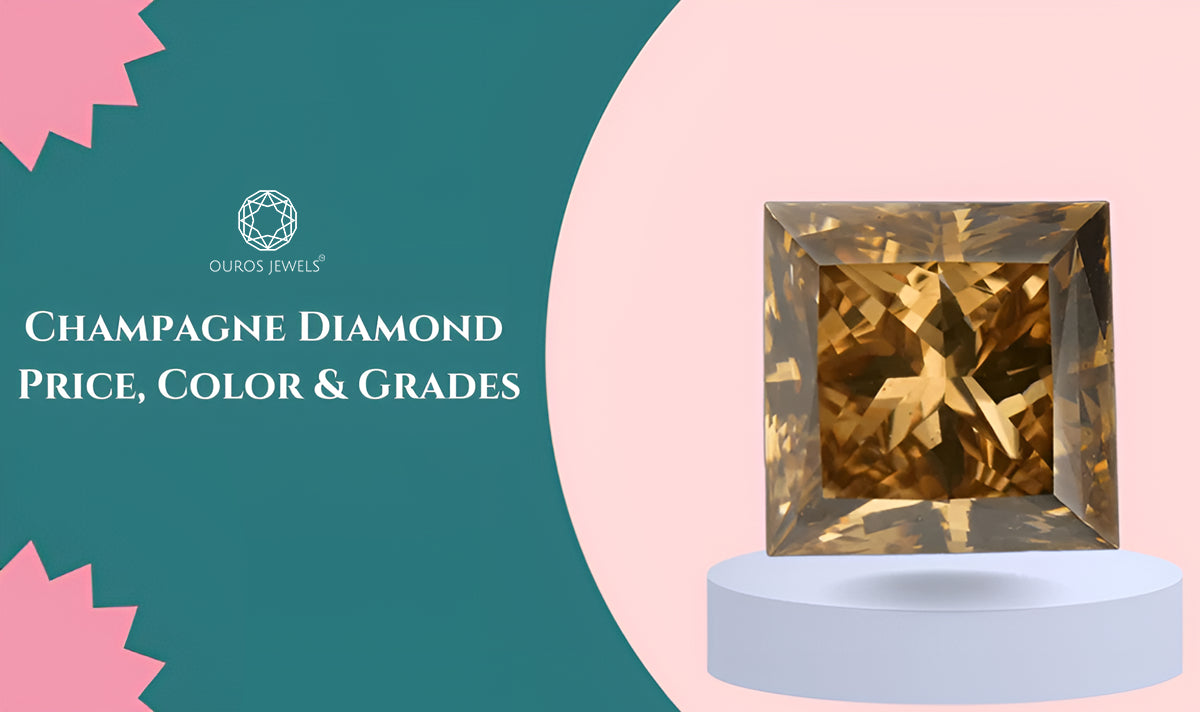
Champagne Diamonds: Everything You Need to Know
![[Champagne Diamond Price And Color Grades Indicates The Stylish Looks]-[ouros jewels]](https://cdn.shopify.com/s/files/1/0527/7669/8040/files/Champagne_Diamond_1024x1024.png?v=1668936156)
Champagne diamonds, with their rich colours and beautiful brilliance, are a luxurious and distinctive option for jewellery. Champagne diamonds range in appearance from delicate beige and warm golden-brown to deeper brown shades, with the name inspired by the colour of champagne. They provide a fashionable alternative to traditional white diamonds and are increasingly popular in engagement rings and fine jewellery.
Champagne diamonds are ideal for people seeking distinctive jewellery that combines traditional diamond beauty with a modern touch. They can be an excellent choice for anyone looking to create a unique style statement.
This guide covers everything you need to know about champagne diamonds, including what they are, how their colour is graded, what makes them unique, how much they can cost, the shapes available, and how to choose champagne diamond jewellery.
What is a champagne diamond?
A champagne diamond is a diamond with a warm brown, yellow-brown or golden-brown appearance. “Champagne” is a trade term commonly used for attractive brown diamonds, particularly those with warm, elegant tones. The colour can range from very light brown through to deeper shades that are sometimes described using terms such as cognac or chocolate.
Champagne diamonds are a type of naturally coloured diamond when their colour occurs naturally, although the term itself is not an official GIA colour grade. Brown is actually the most common fancy diamond colour, and brown diamonds became more popular in jewellery after Australian diamonds were marketed using names such as “champagne” and “cognac”.
The appearance of a champagne diamond depends on its hue, tone, saturation, cut and faceting. A well-cut diamond can return plenty of light through its table and pavilion facets, creating the sparkle and scintillation that buyers look for in diamond jewellery.
Champagne diamonds have become increasingly popular because their warm colour gives jewellery a distinctive appearance compared with traditional colourless diamonds.
![[Champagne Diamond Provides Excellent Apppearance Through Out The Surfaces]-[ouros jewels]](https://cdn.shopify.com/s/files/1/0527/7669/8040/files/Champagne_Diamond_Appearance_480x480.png?v=1668944995)
How is champagne diamond colour graded?
Champagne diamond colour can be described in different ways depending on the diamond and the grading laboratory. It is important not to assume that every champagne diamond automatically has an N-R colour grade.
Under the GIA D-to-Z system, diamonds are graded from D, which represents colourless, through to Z, which represents light yellow, light brown or light grey. N-R falls within the “Very Light” category, while S-Z is classified as “Light”.
Some brown or yellow-brown diamonds can have colour beyond the Z range. These may be assessed as fancy-colour diamonds, with colour described according to hue, tone and saturation. GIA uses terms such as Fancy Light, Fancy, Fancy Intense, Fancy Vivid, Fancy Deep and Fancy Dark for fancy colour diamonds.
![[Champagne Color Diamond Chart To Understand Easily The Grades]-[ouros jewels]](https://cdn.shopify.com/s/files/1/0527/7669/8040/files/Champagne_Diamond_Color_Chart_1024x1024.png?v=1668937037)
The colour of a natural brown diamond is associated with characteristics within its crystal structure. GIA notes that natural brown diamonds can show internal parallel brown grain lines associated with distortion of the crystal lattice.
This is one reason champagne diamonds can look different from one another. One stone may have a subtle golden-brown appearance, while another may have a deeper chocolate or cognac-like tone.
When looking at a champagne diamond, colour should therefore be judged by its actual appearance rather than by the word “champagne” alone.
Are champagne diamonds more affordable?
Champagne diamonds can be more affordable than many other fancy-colour diamonds, particularly rare colours such as vivid pink, blue or green. Brown is one of the more common fancy diamond colours, and champagne-style brown diamonds are available in a wide range of prices.
The final price of a champagne diamond depends on several factors, including:
- Whether the diamond is natural or lab-grown
- Carat weight
- Colour and colour intensity
- Clarity
- Cut quality
- Shape
- Certification
- Whether the colour is natural or the result of treatment
For natural coloured diamonds, colour can have a particularly important influence on value. In fancy-colour diamonds, the strength and purity of the colour can contribute significantly to desirability and price.
Natural vs lab-grown champagne diamonds
Lab-grown diamonds can also be produced with brown or champagne-like colours and can provide an alternative for buyers who want a similar visual appearance at a different price point.
Rather than assuming that one option is always better, buyers should compare the diamond's colour, cut, clarity, carat weight, certification and overall appearance before making a decision.
Do champagne diamonds come in all types of shapes?
Yes. Champagne diamonds are available in many popular diamond shapes, including round, cushion, oval, pear, radiant and emerald cuts.
The shape and faceting pattern can have a noticeable effect on how the brown or golden colour appears. Certain cuts can emphasise the stone's colour, while others may allow more light return and brilliance.
Cushion and radiant cuts are particularly attractive options for coloured diamonds because their faceting can complement and emphasise the stone's colour. Fancy shapes are also commonly used in coloured diamonds to help maximise the visual impact of the colour.
If you are considering a champagne diamond engagement ring, you can therefore choose a shape based on both your personal style and how you want the colour and sparkle of the stone to appear.
Lab-grown champagne or brown diamonds can also be available in a range of shapes. When choosing between a natural and lab-grown diamond, compare the stone's characteristics and certification rather than focusing only on its origin.
Champagne diamond jewellery
Champagne diamond jewellery includes engagement rings, earrings, bracelets and other fine jewellery pieces. These pieces are often selected because of the warm brown and golden colour of champagne diamonds.
Their distinctive colour can work particularly well with different precious-metal choices, including white gold, yellow gold and rose gold.
Champagne diamond engagement ring
![[Champagne diamond ring]-[ouros jewels]](https://cdn.shopify.com/s/files/1/0527/7669/8040/files/Champagne_ring_for_her_480x480.webp?v=1679400174)
Champagne diamond engagement rings are a popular choice for couples who want something different from a traditional colourless diamond.
The brown or golden appearance gives the ring a distinctive character, while the diamond still provides the brilliance and sparkle expected from a diamond engagement ring. Champagne diamonds can therefore offer a balance between classic diamond styling and a more individual look.
When selecting a champagne diamond engagement ring, it is important to consider the 4Cs of diamonds colour, clarity, cut and carat weight as well as the diamond's certification. You can learn more about the 4Cs of diamonds and how they influence diamond quality and value.
A certified diamond can provide important information about the stone's characteristics and, where applicable, whether its colour is natural or treated.
Champagne diamond rings can be particularly appealing to buyers looking for unique engagement rings or fancy colour diamond designs.
Champagne diamond earrings
Champagne diamond earrings are another attractive option for birthdays, anniversaries and other special occasions.
Their warm colour can create a softer and more distinctive appearance than traditional white diamond earrings. Champagne-style diamonds can be set in 14kt or 18kt gold, including white gold, rose gold and yellow gold.
![[Champagne diamond earrings]-[ouros jewels]](https://cdn.shopify.com/s/files/1/0527/7669/8040/files/Champagne_diamond_earring_480x480.webp?v=1674542006)
The choice of metal can change the overall appearance of the earrings. Yellow and rose gold can complement the warm tones of a champagne diamond, while white gold can create greater contrast between the coloured diamond and the setting.
If you are considering champagne diamond earrings, a gemologist can help you understand the diamond colour, cut, clarity and certification before you buy.
Champagne diamond bracelet
A champagne diamond bracelet can be an elegant way to express your personal style or mark a special occasion.
Diamond bracelets can combine several champagne or brown diamonds to create a warm, coordinated appearance. The colour of the diamonds can be particularly attractive when paired with yellow or rose gold.

The price of a champagne diamond bracelet can vary considerably depending on the total carat weight, diamond quality, metal used and whether the diamonds are natural or lab-grown.
For buyers looking for the appearance of champagne diamonds at a different price point, a lab-grown brown or champagne-style diamond bracelet can be worth considering.
Factors that buyers should focus ons
When buying a champagne diamond or champagne diamond jewellery, buyers should pay close attention to the diamond's certification, colour, cut, clarity, symmetry and overall appearance.
A diamond certificate can provide important information about the stone and help buyers make a more informed purchasing decision.
1. Certification
Check whether the diamond comes with a report from a reputable gemological laboratory. For coloured diamonds, a grading report can provide information such as colour grade, colour origin, carat weight, clarity, polish and symmetry.
2. Colour
Colour is one of the most important characteristics of a champagne diamond. Look at whether the stone has a light golden-brown, warm brown, chocolate or deeper cognac-like appearance.
Because “champagne” is a descriptive trade term rather than one universal grading category, compare the actual diamond rather than relying on the name alone.
3. Cut
Cut affects how effectively a diamond returns light. A well-cut champagne diamond can show attractive brilliance and scintillation, helping balance its deeper body colour.
4. Clarity
Clarity is still important, but coloured diamonds can be evaluated somewhat differently from traditional colourless diamonds. In fancy-colour diamonds, an attractive colour can be a major part of the stone's appeal, although inclusions that affect durability remain important.
5. Symmetry and finish
Pay attention to symmetry, polish and overall craftsmanship. A well-proportioned stone with good finishing can improve the appearance of the finished jewellery.
Champagne diamond jewellery, including engagement rings, wedding bands and necklaces, is available in many different designs. From an informed buyer's perspective, checking the certification and diamond characteristics before purchasing is an important step.
Conclusion: Champagne diamonds
Champagne diamonds are distinctive coloured diamonds known for their warm brown, golden-brown and yellow-brown appearances. The term “champagne” is commonly used in the jewellery trade to describe attractive brown diamonds, while formal grading depends on the relevant diamond colour-grading system.
Their combination of colour and brilliance makes them an appealing alternative to traditional colourless diamonds. Buyers looking to make an engagement ring, necklace, bracelet or other piece of jewellery more distinctive may find champagne diamonds particularly attractive.
Whether you choose a natural champagne diamond or a lab-grown diamond with a similar brown or champagne appearance, it is important to compare the colour, cut, clarity, carat weight and certification before purchasing.
If you are looking for a champagne diamond necklace or engagement ring, explore the available options and speak with a qualified jewellery or gemology professional who can help you understand the characteristics of the diamond and choose a suitable design.
FAQs: Champagne diamonds
Q1. What is the difference between champagne and yellow diamonds?
Champagne diamonds generally have brown or yellow-brown tones, often creating a warm, golden or chocolate-like appearance. Yellow diamonds have a predominantly yellow body colour. Both can be naturally coloured diamonds, but their appearance and grading can differ.
The term “champagne” is a trade description rather than an official standalone GIA colour grade. Brown diamonds can fall within the normal D-to-Z range or, when they exhibit colour beyond that range, can be graded as fancy-colour diamonds.
Q2. What are champagne diamonds?
Champagne diamonds are diamonds with warm brown, yellow-brown or golden-brown colour. The name is commonly used in the jewellery trade for attractive brown diamonds, particularly those with champagne-like tones.
They are valued for their distinctive colour and ability to combine diamond brilliance with a warmer appearance.
Q3. How are champagne diamonds graded?
Champagne diamonds are not all graded using one specific “champagne” scale.
If a diamond falls within the normal colour range, its colour can be assessed using the D-to-Z scale. If its colour falls outside the normal range and qualifies as a fancy-colour diamond, the colour is assessed using factors including hue, tone and saturation.
Q4. Are champagne diamonds cheaper than other diamonds?
Champagne diamonds can be more affordable than some rare fancy-colour diamonds, although prices vary significantly. Colour, carat weight, clarity, cut, origin, certification and whether the diamond is natural or lab-grown can all affect the price.
Brown is one of the more common fancy diamond colours, which can make champagne-style diamonds more accessible than rarer fancy colours.
Q5. What makes champagne diamonds unique?
Champagne diamonds are distinctive because of their warm brown and golden colour. Individual stones can vary in hue, tone and saturation, so two champagne diamonds may look noticeably different from one another.
Their colour also gives jewellery a different character from traditional colourless diamond designs.
Q6. Can champagne diamonds be used in all types of jewellery?
Absolutely. Champagne diamonds can be used in many types of jewellery, including engagement rings, earrings, bracelets, necklaces and wedding jewellery.
Their warm colour works with a range of jewellery designs and precious metals, making them suitable for both classic and contemporary styles.
Q7. How do I choose a champagne diamond?
When choosing a champagne diamond, consider the colour and tone you prefer first. Then assess the diamond's cut, clarity, carat weight, symmetry and certification.
It is also worth considering the metal and setting because yellow gold, rose gold and white gold can create different visual effects around a champagne-coloured diamond.
Q8. How should I care for champagne diamond jewellery?
To keep champagne diamond jewellery looking its best, clean it regularly using a soft brush, mild soap and lukewarm water, unless the jewellery manufacturer recommends another method.
Avoid exposing the jewellery to harsh chemicals and have the setting checked periodically, particularly for engagement rings and bracelets that are worn frequently. Regular professional inspection and cleaning can help identify loose stones or other setting issues before they become a problem.


