 Solitaire Rings
 Halo Rings
 Bezel Rings
 Three Stone Rings
 Five Stone Rings
 Bridal Set Rings
 Solitaire Accent Rings
 Toi Moi Rings
 Curved Rings
 Semi Mount Rings
 Custom Rings
 Color Diamond Rings
 Lab Gemstone Rings
 Men's Rings
 Round
 Pear
 Oval
 Princess
 Asscher
 Marquise
 Emerald
 Cushion
 Radiant
 Heart
 Old Cuts
 Tennis Bracelet
 Fashion Bracelet
 Pendant
 Necklace
 Men's Jewelry
 Eternity Bands
 Dainty Bands
 Custom Bands
 Men’s Bands
 Studs
 Hoops
 Jackets
 Dangle
 Bridal
 Pink
 Champagne
 Yellow
 Blue
 Black
 Green
 Olive
 Emerald
 Ruby
 Sapphire
 Other Gemstone
 Old Cut Jewelry
 Antique Diamond Jewelry
 Kids Collection
 Celebrity Jewelry
 Round
 Princess
 Asscher
 Cushion
 Radiant
 Emerald
 Heart
 Pear
 Oval
 Marquise
 Matching Pair
 Old Cut
 Antique Cut
 Rose Cut
 Step Cut
 Portuguese Cut
 Portrait Cut
 Champagne
 Pink
 Yellow
 Blue
 Other
 Emerald
 Ruby
 Sapphire
 IGI-GIA Certified
 8X Diamond
 Ready Stocks
 Ready In Stock
 OEC Round
 Old Mine Cushion
 Old Mine Asscher
 Old Mine Emerald
 Old Mine Moval
 Old Mine Pear
 Bands
 Earrings
 Bracelets
 Necklace
 Anniversary Gift
 Birthday Gift
 Gift For Her
 Gift For Him
 Under 300$
 Under 500$
 Gift Card
 Check Balance
 REVIEW
 +1 (551) 274-2892
 contact@ourosjewels.com

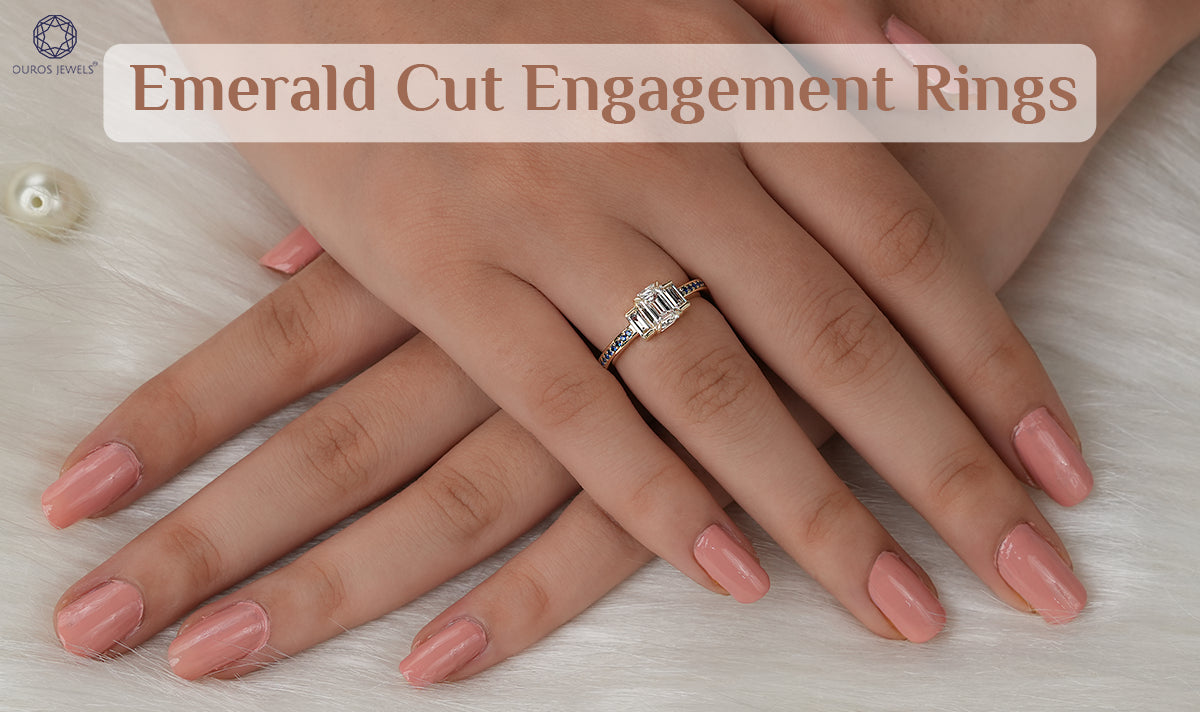
Emerald Cut Diamond Engagement Rings: The Comprehensive Buying Guide
Summarize this post with AI

If you're planning to express your love and commitment, an emerald cut engagement ring is an elegant choice. This distinctive diamond shape symbolises more than your relationship; it can serve as a lasting reminder of love, honesty and loyalty.
Emerald cut diamonds are renowned for their elegant step-cut design, broad facets and clean appearance, which create the distinctive “Hall of Mirrors” effect as light reflects through their precisely arranged facets and polished surfaces. Unlike brilliant-cut diamonds, emerald cuts are designed to produce a more understated, elegant pattern of light rather than intense sparkle.
Emerald Cut Diamond Engagement Rings
You and your partner share a strong passion for your relationship. Often, you might look for support from someone who knows you well, while your partner seeks affection and warmth. This is the essence of being in a loving relationship, and trust is crucial to keeping that bond strong.
This guide will help you find an engagement ring that reflects the strength and beauty of your relationship.
When choosing an emerald cut diamond ring, it is important to consider the 4Cs of diamonds — colour, clarity, cut and carat weight to understand the quality and characteristics of your chosen gemstone. The 4Cs are the established framework used to communicate diamond quality, although each factor can affect the appearance and value of a stone differently.
An engagement ring is not simply a piece of jewellery; for many couples, it is a meaningful expression of their commitment. Alongside the 4Cs, there are other factors to consider, including proportions, length-to-width ratio, symmetry, polish, metal and ring design.
Let's start our journey into emerald cut engagement rings.
What Does an Emerald Cut Engagement Ring Mean?
Emerald cut engagement rings are often associated with independence, clarity, honesty and self-control. The clean, open appearance of an emerald cut diamond gives it a distinctive elegance compared with more heavily faceted brilliant-cut shapes.
An emerald cut is usually rectangular or square-leaning in outline, with step-cut facets, parallel concentric rows and cropped or bevelled corners. These broad facets create the characteristic hall-of-mirrors appearance associated with the shape.
The elongated rectangular outline can also make an emerald cut appear larger from the top than another diamond of the same carat weight, depending on its proportions.
Rather than producing the intense scintillation associated with a round brilliant or radiant cut, an emerald cut creates broad flashes and reflections across its large facets. This understated optical effect is one of the reasons the shape appeals to people looking for an elegant and sophisticated engagement ring.
The concentric facet arrangement allows light to reflect through the crown and pavilion, while the bevelled corners contribute to the distinctive appearance and can provide additional protection compared with sharp corners.
Why Choose an Emerald Cut Engagement Ring?
Emerald cut diamonds use a step-cut faceting style rather than the brilliant faceting used in shapes such as radiant and round brilliant diamonds. Their broad, open facets give them a distinctive appearance and make them particularly suitable for buyers who prefer clarity, symmetry and elegant flashes of light.
One important consideration is that the broad facets of an emerald cut can make colour and inclusions easier to see. GIA specifically notes that inclusions are generally more noticeable in emerald cuts than in brilliant-cut diamonds because step cuts have larger, fewer facets.

Here are some of the main reasons to consider an emerald cut engagement ring.
It's a Cost-Saving Alternative to a Round Brilliant
Emerald cut diamonds can offer a more affordable alternative to round brilliant diamonds of comparable characteristics. Fancy shapes can sometimes provide a way to prioritise a distinctive centre stone while managing the overall budget.
For example, the original guide uses the following illustrative comparison:
|
Shape |
Carat |
Clarity |
Colour |
Cut |
Illustrative Price |
|
Emerald |
1.00 |
VS2 |
E |
Excellent |
$1,000 |
|
Round |
1.00 |
VS2 |
E |
Excellent |
$1,100 |
|
Radiant |
1.00 |
VS2 |
E |
Excellent |
$1,500 |
The original comparison uses “cut” terminology for all three shapes. For UK buyers comparing laboratory reports, remember that GIA's official overall cut grade currently applies to standard round brilliant diamonds, not emerald or other fancy shapes.
These prices are illustrative rather than current UK retail prices. The actual cost of a diamond depends on factors including colour, clarity, carat weight, proportions, symmetry, polish, fluorescence, laboratory report and whether the stone is natural or laboratory-grown.
When you want to balance quality and budget, an emerald cut can therefore be worth considering alongside a round brilliant or radiant diamond.
The Flashes and Light Reflections
An emerald cut diamond produces broad reflections through its step-cut facets and bevelled corners. The concentric arrangement of the facets creates the characteristic hall-of-mirrors effect rather than the intense, fragmented sparkle associated with brilliant cuts.
If you prefer the elongated appearance of a radiant or rectangular diamond but want a cleaner, more understated visual effect, an emerald cut can provide an appealing alternative.
The symmetry of the diamond is also important because the step-cut pattern is relatively open and easy to observe.
Length: A Unique Selection Point
The length of an emerald cut diamond is one of its most distinctive features. If your partner prefers a rectangular diamond, the length-to-width ratio (L/W ratio) deserves particular attention.
An elongated emerald cut can create a longer visual line across the finger, giving the ring a sophisticated and sleek appearance.
This elongated outline works particularly well with:
- Solitaire rings
- Three-stone rings
- Halo rings
- Vintage-inspired designs
- Art Deco styles
- Toi et Moi rings
Because the outline is so visible, choosing the right proportions is particularly important.
Clarity and Transparency
The broad, step-cut facets of an emerald diamond create its clean, transparent appearance. However, these same facets can also make inclusions easier to see.
For this reason, clarity deserves particular attention when buying an emerald cut diamond. GIA notes that inclusions can be more visible in emerald cuts than in brilliant-cut diamonds because of their larger, less numerous facets.
A higher clarity grade can therefore be particularly useful if you want a clean-looking emerald cut diamond.
The result is a timeless appearance that works across both traditional and contemporary engagement ring designs.
Versatility
If you want an engagement ring with a distinctive appearance, the emerald cut is a versatile choice.
It can be incorporated into:
- Solitaire rings
- Three-stone rings
- Halo rings
- Vintage-inspired designs
- Art Deco rings
- Toi et Moi rings
- Cluster designs
Emerald cut diamonds can also be paired with yellow gold, rose gold, white gold or platinum, depending on the appearance you want.
A solitaire emerald cut ring offers a clean and sophisticated look, while a halo design can add visual presence around the centre stone. A three-stone design provides additional symbolism, while a vintage-inspired setting can emphasise the geometric character of the emerald cut.
The Ideal 4Cs of Diamonds to Choose
As mentioned in the introduction, the 4Cs of diamonds are important when selecting an emerald cut engagement ring.
The 4Cs are:
- Colour
- Clarity
- Cut
- Carat weight
These characteristics influence a diamond's appearance, rarity and value. GIA describes the 4Cs as the defining characteristics used to communicate diamond quality.
However, emerald cut diamonds require some additional attention because their step-cut facets reveal colour and clarity more readily than many brilliant-cut diamonds.
Select D to J Colour Grades
The original guide recommends the D to J colour range for emerald cut diamonds.
D is at the colourless end of the GIA D-to-Z scale, while lower grades can show progressively more warmth. The best choice depends on your preferred appearance, metal and budget.
The metal can influence how the diamond's colour is perceived. For example, very white metals can make body colour more noticeable, while yellow gold can complement warmer diamond colours.
For an emerald cut, colour deserves particular attention because its broad facets can make body colour easier to observe.
Rather than automatically choosing the highest colour grade, compare stones in person or through high-quality imagery and consider how the diamond looks in its intended setting.

Choose 1 to 5 Carat Weights
Carat weight describes the weight of the diamond rather than its physical dimensions.
An elongated emerald cut can appear relatively large for its carat weight because of its rectangular outline. However, carat weight should always be considered alongside the diamond's measurements and proportions.
The original guide recommends considering 1 to 5 carats, depending on the ring design and personal preference.

For example:
- A 1 or 2-carat emerald cut can work well in a solitaire setting.
- A larger centre stone can create more presence in a halo or vintage-inspired design.
- A three-stone ring requires consideration of the centre stone alongside its accent diamonds.
Remember that two emerald cut diamonds with the same carat weight can look noticeably different if their length-to-width ratios and depth proportions differ.
Assess Cut Quality Through Proportions, Symmetry and Finish
For emerald cuts, avoid treating a generic “Excellent” cut grade as though it were equivalent to the official GIA cut grade assigned to a round brilliant.
GIA currently provides overall cut grades from Excellent to Poor for standard round brilliant diamonds; emerald cuts are fancy shapes and do not currently receive an overall GIA cut grade.
For an emerald cut, instead examine:
- Table percentage
- Total depth
- Crown dimensions
- Girdle thickness
- Length-to-width ratio
- Symmetry
- Polish
- Facet alignment
- Overall light performance
The proportions and facet arrangement determine how the diamond interacts with light, so two emerald cuts with similar carat weights can have noticeably different appearances.
Select VVS to VS Clarity - But Judge the Actual Stone
The original guide recommends VVS to VS clarity for emerald cut diamonds.
This is a useful starting point because the broad facets of a step-cut diamond can make inclusions easier to see. GIA specifically recommends paying attention to clarity when buying an emerald cut for this reason.
The relevant clarity grades include:
- VVS1
- VVS2
- VS1
- VS2
However, you should not automatically pay for the highest clarity grade available. The location, size and nature of inclusions matter, so compare the actual diamond and its grading report.
An emerald cut with a slightly lower clarity grade may still appear clean to the naked eye, while a poorly positioned inclusion can be more noticeable in another stone.
The Importance of Symmetry and Polish
You should not ignore symmetry and polish when buying an emerald cut engagement ring.
Symmetry refers to how accurately the diamond's shape and facets are aligned, while polish describes the quality of the finished facet surfaces. Both contribute to the overall appearance of the diamond.
Because emerald cuts have long, straight facet lines and a relatively open pattern, symmetry can be particularly noticeable.
The original guide provides the following selection framework:
|
Ring Style |
Suggested Carat Range |
Symmetry |
Polish |
|
Halo |
1.00–2.00 |
Excellent |
Very Good |
|
Three-stone |
1.50–3.00 |
Very Good |
Very Good |
|
Vintage |
2.00–3.50 |
Excellent |
Good |
|
Solitaire |
1.00–1.50 |
Excellent |
Excellent |
|
Toi et Moi |
0.50–2.50 |
Very Good |
Excellent |
|
Bridal Set |
1.50–3.00 |
Very Good |
Very Good |
|
Dainty |
0.50–4.00 |
Excellent |
Good |
|
Unique |
0.70–3.50 |
Excellent |
Very Good |
These should be treated as selection guidelines rather than universal grading rules. The appropriate combination depends on the individual stone, ring design, budget and personal preference.
The L/W Ratio of an Emerald Cut Diamond
The L/W ratio, or length-to-width ratio, compares the length of an emerald cut diamond with its width.
For a more squarish emerald cut, the original guide suggests an L/W ratio around 1.30 to 1.50.
If you prefer a more elongated appearance, a ratio around 1.60 to 1.80 can create a longer rectangular outline.
The choice is ultimately visual. A lower ratio creates a squarer appearance, while a higher ratio produces a more elongated look.
When choosing an emerald cut engagement ring, compare the actual measurements rather than relying on the ratio alone. The L/W ratio should be considered together with table, depth, facet arrangement and overall symmetry.

The Proportions for the Best Emerald Cut Diamond Ring
The proportions of an emerald cut include its:
- Table
- Total depth
- Crown height
- Girdle thickness
- Length
- Width
Choosing suitable proportions can influence the diamond's face-up appearance and interaction with light.
The original guide provides the following reference ranges:
|
Proportion |
Excellent |
Very Good |
Good |
Fair |
Poor |
|
Table % |
60–67% |
59–69% |
57–72% |
53–76% |
50–78% |
|
Crown Height % |
12–16% |
11–17% |
10–18% |
7–20% |
6–25% |
|
Total Depth % |
55–65% |
60–68% |
62–72% |
56–78% |
53–80% |
|
Girdle Thickness |
Very Thin–Slightly Thin |
Slightly Thin–Thick |
Very Thin–Thick |
Slightly Thick–Thick |
Thick–Extremely Thick |
Important: these labels should not be interpreted as official GIA cut grades for emerald cuts. GIA's overall cut-grade system currently applies to standard round brilliant diamonds. For an emerald cut, use proportion ranges as a comparison tool and assess the individual stone's symmetry, polish, facet alignment and visual performance.
Emerald Cut Engagement Ring Styles
There are many emerald cut engagement ring styles, and each has its own character.
The most popular designs include:
|
Ring Style |
Why Choose It |
Attribute/Meaning |
Suggested Use |
Original Illustrative Price |
|
Halo |
Adds surrounding brilliance |
Gratitude |
14KT/18KT white gold with colourless accents |
1,000–3,000 |
|
Three-stone |
Cost-effective multi-stone design |
Love, romance and promise |
14KT yellow gold with coloured diamonds |
900–2,000 |
|
Vintage |
Creates a distinctive, decorative appearance |
Luxury and opulence |
1.50-carat elongated emerald cut |
2,000–4,000 |
|
Solitaire |
Style and elegance |
Fidelity and commitment |
Rectangular emerald cut |
1,500–3,000 |
|
Toi et Moi |
Bypass-style design |
Faith and trust |
Coloured emerald cut up to 3 carats |
1,300–4,000 |
|
Semi-mount |
Alternative to a complete solitaire |
Promise and loyalty |
Small square or rectangular emerald |
500–2,500 |
|
Dainty |
Curved, delicate band |
Support and dedication |
Emerald cut accents with 18KT yellow gold |
1,800–3,000 |
|
Unique |
Distinctive appearance |
Connection and goodwill |
1.00-carat, VVS, E colour |
1,700–3,000 |
|
Cluster |
Strong decorative presence |
Honesty and modesty |
Around 2.00-carat centre stone |
2,000–3,500 |
Prices above are retained from the original guide and are illustrative USD figures, not current UK retail prices.
Emerald Cut Solitaire Engagement Ring
A solitaire engagement ring places the emerald cut diamond at the centre of attention.
The original example features a 2.60-carat emerald cut laboratory-grown diamond, with VVS clarity and E colour, set in 18KT yellow gold.

A solitaire can be an impressive choice for couples who prefer a clean, understated design. A sufficiently substantial band can also provide a balanced appearance and comfortable everyday wear.
Buying tip: For a rectangular emerald cut solitaire, an L/W ratio around 1.50 can create a balanced elongated appearance. Consider clarity, colour, proportions, symmetry and polish together rather than relying on a single grade. For a square emerald cut, adjust the proportions according to the outline you prefer.
Three-Stone Emerald Cut Engagement Ring
The three-stone engagement ring traditionally represents love, romance and promise. With an elongated emerald centre stone, you can combine colourless or coloured accent diamonds depending on the design.
A three-stone setting can also be a cost-conscious alternative to some more elaborate halo designs.
Baguette or shield-cut accent stones can complement the geometric appearance of an emerald cut centre stone.

The original guide uses a 2-carat laboratory-grown emerald cut as an example. As with any engagement ring, the final price varies according to diamond quality, metal, setting and design.
For a three-stone ring, the band should be proportionate to the centre stone and side stones rather than simply being thick or thin. Ring size and everyday comfort should also be considered.
Buying tip: A 1.00–2.00-carat centre stone can work well in a three-stone design, but the ideal size depends on the proportions of the accent stones and the overall ring. Prioritise your partner's preference for metal colour and design.
Emerald and Pear Diamond Toi et Moi Ring
The combination of an emerald cut and pear-shaped diamond brings together two contrasting silhouettes.
The emerald cut is known for its clean, step-cut appearance, while the pear shape creates a teardrop outline.
A Toi et Moi ring meaning “you and me” uses two prominent stones to represent two people coming together. It can therefore be a meaningful choice for an engagement ring.

The two stones do not necessarily need identical dimensions, but balancing their visual weight helps create a cohesive design.
The original example uses two 2.00-carat laboratory-grown diamonds: an emerald cut centre stone and a pear-shaped stone, both with VS clarity and FG colour, set in 18KT rose gold.
Buying tip: Claw-prong settings can provide secure positioning for the stones while allowing more of the diamond to remain visible. Compare the two stones for colour, clarity, proportions and visual balance before finalising the setting.
Emerald Cut Diamond Cluster Engagement Ring
A cluster engagement ring combines multiple stones to create a more decorative appearance.
The original guide associates the cluster style with honesty and modesty and recommends considering a 1- or 2-carat emerald cut centre stone, complemented by shield or baguette accent diamonds.

When choosing a cluster setting, pay particular attention to the formation and symmetry of the surrounding stones.
For a traditional appearance, 14KT or 18KT yellow gold can complement an emerald cut centre stone. Rose or white gold can also work well with fancy-coloured diamonds.
Buying tip: VVS clarity can be a useful starting point for a cluster design because multiple stones are visible together. However, judge each diamond individually rather than choosing a grade in isolation. Keep the centre stone, accent stones and setting proportionate to one another.
Blue Emerald Cut Engagement Ring
A blue emerald cut diamond can bring a distinctive colour accent to an engagement ring.
The elongated outline and step-cut facets give the stone a clean appearance, while the blue colour creates a more contemporary alternative to a traditional colourless centre stone.
When selecting a blue emerald cut diamond, clarity remains important because the broad step facets can reveal inclusions.
For an elongated blue emerald cut, consider the length-to-width ratio carefully. For a square emerald cut, the preferred proportions will differ.

A blue centre stone can be incorporated into three-stone, halo, solitaire and other engagement ring designs.
The original guide suggests a budget of around $3,000 for selected three-stone and halo styles and recommends considering VVS clarity, vivid/fancy blue colour, 1–5 carat weight and strong overall proportions.
Buying tip: When buying a coloured emerald cut diamond, assess the colour itself as well as clarity, carat weight, proportions, symmetry and the quality of the setting.
Rose Gold Emerald Cut Engagement Ring
A rose gold emerald cut engagement ring combines the warm pink tone of the metal with the clean geometry of the emerald cut.
If you are looking for an engagement ring with a romantic appearance, rose gold can complement both colourless and fancy-coloured emerald cut diamonds.
For an elongated emerald cut, an L/W ratio around 1.50:1 can provide a balanced rectangular appearance, although the ideal ratio depends on your preferred look.

Emerald cut diamonds have bevelled corners and clean step facets, making them particularly suitable for geometric and vintage-inspired settings.
Rose gold can be used with:
- Solitaire settings
- Halo settings
- Three-stone rings
- Pavé bands
- Vintage-inspired designs
The original guide suggests an illustrative price range of 1,500–3,500 for selected rose gold pavé designs.
Buying tip: When buying a gold engagement ring in the UK, check the hallmark or purity information, such as 9ct, 14ct or 18ct gold. For a pavé design, make sure the accent stones and setting complement the emerald cut centre stone.
What Price Should You Pay for an Emerald Cut Engagement Ring?
The original guide places emerald cut engagement rings in an illustrative range of $1,000 to $5,000, depending on the diamond, setting, metal and design.
For UK shoppers, these figures should not be treated as current GBP retail prices. Actual prices vary between jewellers and can change according to the natural or laboratory-grown origin of the diamond, grading report, metal, craftsmanship and market conditions.
The main factors affecting the price include:
- Colour
- Clarity
- Carat weight
- Cutting quality and proportions
- Symmetry
- Polish
- L/W ratio
- Natural or laboratory-grown origin
- Metal
- Ring style
- Setting
- Accent diamonds
The 4Cs are an important starting point, but the visual appearance of the actual diamond should also be considered.
Laboratory-grown emerald cut diamonds can offer additional options at different price points. If you are comparing laboratory-grown and natural diamonds, check that you understand the origin stated on the relevant grading documentation.
The original guide provides the following illustrative comparison:
|
Ring Style |
Carat |
Colour |
Clarity |
Cut* |
Original Illustrative Price |
|
Halo |
1.00 |
D |
VVS |
Excellent |
$1,500 |
|
Solitaire |
1.50 |
D |
VVS/VS |
Excellent |
$1,800 |
|
Three-stone |
2.00 |
D |
VVS |
Excellent |
2,500–3,000 |
|
Vintage |
2.00 |
D |
VVS |
Excellent |
$2,700 |
|
Toi et Moi |
2.00 |
D |
VVS |
Excellent |
$2,800 |
For emerald cuts, “Excellent” should not be confused with an official GIA overall cut grade, which currently applies to standard round brilliant diamonds.
When allocating a budget, consider these factors together:
- 4Cs of the emerald cut diamond
- Diamond symmetry
- Polish
- Metal colour
- Metal purity
- Ring style
- Prong setting
- Natural or laboratory-grown origin
- Grading report
A diamond grading report provides important information about the stone's characteristics, while the remaining choices depend more heavily on your personal preferences and ring design. GIA recommends using an independent grading report to understand what you are buying.
Which Is the Best Metal for Emerald Cut Rings?
The original guide highlights rose and white gold as popular choices for emerald cut engagement rings because both provide a clean and elegant setting for the rectangular stone.
However, there is no single metal that is right for every emerald cut ring. Your choice can depend on colour preference, durability requirements, design and budget.
|
Metal |
Tone |
Common Purity |
Main Characteristic |
Relative Cost |
|
Silver |
White |
925/935 |
Affordable white-metal appearance |
Generally lower |
|
Gold |
Yellow/Rose/White |
9ct/10ct/14ct/18ct |
Versatile and available in several colours |
Generally higher than silver |
|
Platinum |
White |
950 |
Dense, durable and premium appearance |
Generally higher than gold |
For UK buyers, 9ct and 18ct gold are particularly relevant options, alongside platinum and sterling silver. Always check the applicable hallmark information when purchasing precious-metal jewellery.
White gold can create a clean, contemporary appearance, yellow gold provides warmth and contrast, while rose gold gives the ring a softer pink tone.
Shop Emerald Cut Engagement Rings
Shop Emerald Cut Engagement Rings
Conclusion
Buying an emerald cut diamond engagement ring can be simple and enjoyable when you understand what to look for.
The shape is recognised by its elongated or rectangular outline, bevelled corners and step-cut facets. Its broad, open facets create the distinctive hall-of-mirrors effect, giving the diamond an elegant pattern of reflections rather than the intense sparkle of a brilliant-cut stone.
Emerald cuts can also be an attractive alternative to round brilliant diamonds when you want a distinctive centre stone and need to manage your budget. However, because the broad facets make colour and clarity more visible, these characteristics deserve particular attention.
When choosing an emerald cut diamond, consider:
- Colour
- Clarity
- Carat weight
- Proportions
- L/W ratio
- Symmetry
- Polish
- Metal
- Ring style
- Grading report
For an engagement ring, it is also worth considering your partner's preferred metal colour, ring style, band width and ring size.
A jeweller can help you compare individual diamonds and determine how their proportions work with your chosen setting.
The original guide gives an illustrative price range of 1,000–5,000. UK buyers should treat this as a historical/illustrative range rather than a current GBP price guide, because actual prices vary according to diamond origin, quality, metal, setting and supplier.
For customised options, visit our customising page to explore emerald cut engagement ring designs and alternatives.
FAQs About Emerald Cut Diamond Engagement Rings
Q1. Should I choose a fancy-colour diamond for an emerald cut engagement ring?
Yes. You can choose a fancy-colour diamond for an emerald cut engagement ring if you prefer a coloured centre stone.
Fancy-colour diamonds are available in colours including blue, pink, yellow, orange, red, champagne, brown, purple and other hues.
The best colour depends on your personal preference and the overall design of the ring.
Q2. What is the difference between emerald cut and princess cut diamond rings?
An emerald cut is typically rectangular or square-leaning and uses step-cut facets with bevelled corners. A princess cut is generally square or rectangular with a brilliant-style faceting arrangement.
The main difference is therefore not simply the outline but the cutting style and facet arrangement.
Emerald cuts create the broad, reflective hall-of-mirrors appearance associated with step cuts, while princess cuts are designed to create more brilliant-style sparkle.
Q3. Are emerald cut diamond rings more expensive than other diamond cuts?
Not necessarily.
Emerald cut diamonds can sometimes cost less than round brilliant diamonds with comparable characteristics, although the final price depends on colour, clarity, carat weight, proportions, diamond origin, setting and metal.
The specific diamond should always be compared rather than assuming that one shape will always be cheaper.
Q4. Does rose gold look good with an emerald cut engagement ring?
Yes. Rose gold can complement the geometric appearance of an emerald cut diamond by introducing a warm pink tone.
Rose gold is available in different purities, including 9ct, 14ct and 18ct, depending on the market and manufacturer.
The right choice depends on your preferred colour, durability requirements and overall ring design.
Q5. Is an emerald cut three-stone engagement ring a stylish choice?
A three-stone emerald cut engagement ring combines a geometric centre stone with two additional diamonds or gemstones.
The three-stone design is traditionally associated with love, romance and promise. You can choose either an elongated or squarer emerald cut depending on your preferred appearance.
Baguette and shield-cut accent stones can also complement the straight lines of an emerald cut.
Q6. Are emerald cut engagement rings a good investment?
An engagement ring can hold sentimental value, but it should not automatically be treated as a financial investment.
Diamond prices can vary according to market conditions, diamond characteristics, origin, rarity, brand and resale demand. There is no guarantee that an engagement ring will retain or increase its original purchase price.
If resale value matters to you, research the specific diamond, grading report, purchase terms and secondary-market conditions before buying.
Q7. Does a 1-carat emerald cut engagement ring look unique?
Yes. A 1-carat emerald cut diamond can have a distinctive appearance because of its elongated outline and step-cut facets.
You can use a 1-carat emerald cut in:
- Halo rings
- Solitaire rings
- Vintage designs
- Three-stone rings
- Contemporary settings
Pay attention to the diamond's measurements and L/W ratio, not only its carat weight.
Q8. Can I choose a laboratory-grown emerald cut diamond engagement ring?
Yes. Laboratory grown emerald cut diamonds are available in a wide range of colours, clarity grades, carat weights and proportions.
They are diamonds with the same basic chemical composition and crystal structure as natural diamonds, but their origin is different.
If you are comparing laboratory-grown and natural diamonds, consider the differences in price, origin, grading documentation and your own purchasing priorities.
You can explore lab-created fancy-colour diamonds if you are interested in coloured options.
Q9. What is an affordable price range for an emerald cut engagement ring?
There is no single affordable price range because budgets vary considerably between buyers.
The original guide uses 1,000–5,000 as an illustrative range for emerald cut engagement rings. For UK shoppers, the actual equivalent price in pounds will vary according to current exchange rates, retailer pricing, diamond origin, metal, setting and quality.
Instead of choosing a budget based only on carat weight, decide which factors matter most to you — such as clarity, colour, size, proportions, metal and ring style — and compare diamonds accordingly.