
 Solitaire Rings
 Halo Rings
 Bezel Rings
 Three Stone Rings
 Five Stone Rings
 Bridal Set Rings
 Solitaire Accent Rings
 Toi Moi Rings
 Curved Rings
 Semi Mount Rings
 Custom Rings
 Color Diamond Rings
 Lab Gemstone Rings
 Men's Rings
 Round
 Pear
 Oval
 Princess
 Asscher
 Marquise
 Emerald
 Cushion
 Radiant
 Heart
 Old Cuts
 OEC
 OMC
 OMM
 Tennis Bracelet
 Fashion Bracelet
 Pendant
 Necklace
 Men's Jewelry
 Eternity Bands
 Dainty Bands
 Custom Bands
 Men’s Bands
 Studs
 Hoops
 Jackets
 Dangle
 Bridal
 Pink
 Champagne
 Yellow
 Blue
 Black
 Green
 Olive
 Emerald
 Ruby
 Sapphire
 Other Gemstone
 Old Cut Jewelry
 Antique Diamond Jewelry
 Kids Collection
 Celebrity Jewelry
 Round
 Princess
 Asscher
 Cushion
 Radiant
 Emerald
 Heart
 Pear
 Oval
 Marquise
 Matching Pair
 Old Cut
 Antique Cut
 Rose Cut
 Step Cut
 Portuguese Cut
 Portrait Cut
 Champagne
 Pink
 Yellow
 Blue
 Other
 Emerald
 Ruby
 Sapphire
 IGI-GIA Certified
 8X Diamond
 Ready Stocks
 Ready In Stock
 OEC Round
 Old Mine Cushion
 Old Mine Asscher
 Old Mine Emerald
 Old Mine Moval
 Old Mine Pear
 Bands
 Earrings
 Bracelets
 Necklace
 OEC Jewelry
 Anniversary Gift
 Birthday Gift
 Gift For Her
 Gift For Him
 Under 300$
 Under 500$
 Gift Card
 Check Balance
 REVIEW
 +1 (551) 274-2892
 contact@ourosjewels.com
What Are Diamond Alternatives or Substitutes? A Detailed Guide
Summarize this post with AI

Choosing an engagement ring is one of the most memorable parts of a proposal. Imagine planning a surprise engagement, carefully arranging every detail and preparing to ask your partner to spend the rest of their life with you. The ring becomes an essential part of that special moment. However, you do not necessarily need a traditional mined diamond to create a beautiful and meaningful piece of jewellery.
If you are looking for diamond alternatives, there are several beautiful and affordable options available. These include gemstones that offer a diamond like appearance as well as colourful alternatives that bring their own distinctive charm. They can be used in engagement rings, wedding bands, earrings, pendants, bracelets and other fine jewellery.
Have you heard the terms diamond alternative or diamond substitute? These terms are commonly used in the jewellery industry, but they do not describe exactly the same type of gemstone. Let's understand what they mean.
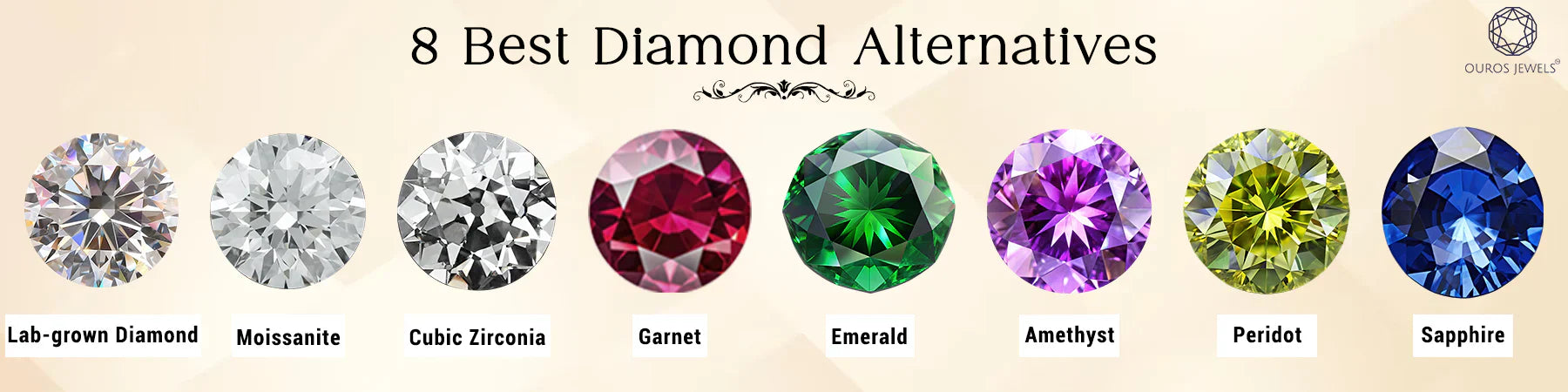
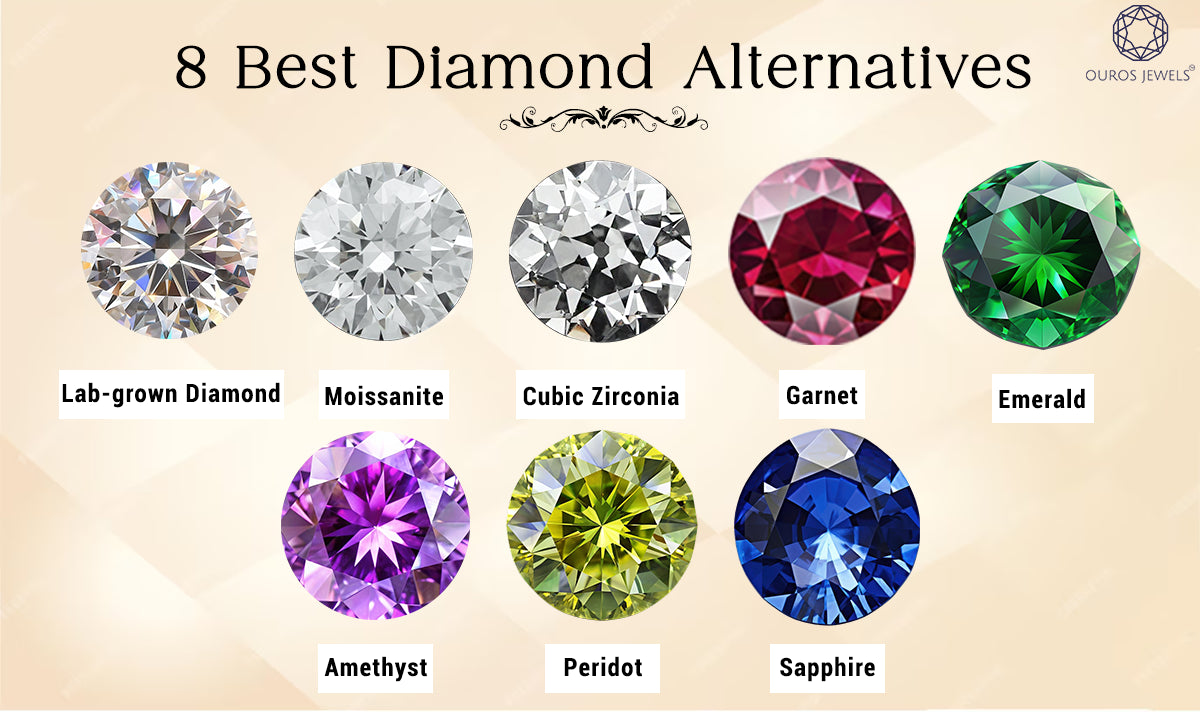
Diamond alternatives include gemstones with attractive optical properties, durability and different colour and shape options. Some, such as moissanite and cubic zirconia, are diamond simulants designed to resemble diamonds. Others, such as garnet, emerald, amethyst, peridot and sapphire, offer a distinctive alternative through their natural colours and individual characteristics.
One of their biggest attractions is affordability. Many diamond alternatives cost considerably less than mined diamonds, allowing buyers to explore different gemstone sizes, colours and jewellery designs within their budget.
In a world where engagement rings and fine jewellery offer an expanding range of choices, finding the right gemstone can be an exciting journey. While natural diamonds have been a traditional choice for decades, diamond alternatives have gained popularity among people seeking affordability, distinctive beauty and more choice.
These gemstones offer a range of benefits, from different sourcing options and accessible prices to captivating brilliance and colour. In this guide, we explore the special qualities that set diamond alternatives apart and explain how to choose the right gemstone for your jewellery.
Discover the world of lab grown diamonds, moissanite and other gemstone alternatives that are changing the landscape of fine jewellery. Whether you are looking for an engagement ring or a beautiful piece of jewellery that reflects your values and personal style, join us on this journey through the world of brilliant, distinctive and affordable diamond alternatives.
Chapter I: Introduction
Couples are passionate about their relationships and often look for ways to make important milestones more memorable. When two people trust each other and decide to build a future together, an engagement becomes a meaningful promise of commitment.
Choosing an engagement ring is an important part of that experience. Couples explore different engagement ring designs, whether a solitaire, halo, infinity band or a contemporary setting featuring diamonds or coloured gemstones.
Today jewellery buyers are also increasingly interested in the ethical and environmental considerations associated with gemstones. They want to understand where their chosen stones come from, how they are produced and whether responsible practices are followed throughout the supply chain.
If these considerations matter to you, diamond alternatives offer several possibilities. They can provide the appearance you want in an engagement ring or fine jewellery while giving you more flexibility in terms of colour, shape, size and budget.
Popular alternatives include lab grown diamonds, moissanite, cubic zirconia and coloured gemstones such as garnet, emerald, amethyst, peridot and sapphire.
However, it is important to understand that these gemstones do not all share the same characteristics as mined diamonds. Lab grown diamonds are real diamonds, while moissanite and cubic zirconia are diamond simulants. Coloured gemstones have their own optical properties, durability levels and distinctive beauty.
For buyers who find a mined diamond engagement ring expensive, these alternatives provide additional opportunities to choose jewellery that reflects their relationship and personal preferences.
1. What Are Diamond Alternatives or Replacement Gemstones?
Diamond alternatives are gemstones chosen instead of traditional mined diamonds in jewellery. They may be selected for their brilliance, colour, durability, affordability or distinctive appearance.
Some alternatives closely resemble diamonds, while others offer a completely different look. Their suitability depends on the type of jewellery, the wearer's preferences and the expected frequency of use.
For example:
- Lab grown diamonds: Real diamonds created in controlled laboratory environments, with essentially the same chemical, physical and optical properties as mined diamonds.
- Moissanite: A silicon carbide gemstone known for its exceptional brilliance, fire and durability.
- Cubic zirconia: A laboratory created diamond simulant valued for its affordability and diamond like appearance.
- Coloured gemstones: Natural or laboratory created gemstones such as garnet, emerald, amethyst, peridot and sapphire.
One of the main reasons people choose these stones is their affordability. Many alternatives allow buyers to explore larger gemstones or more elaborate jewellery designs without spending as much as they might on a comparable mined diamond.
But you may still have a question: What is better than a diamond?
There is no single answer because the best gemstone depends on what you value most. If you want a real diamond with a more accessible price, a lab grown diamond may be suitable. If you prefer exceptional sparkle, moissanite is worth considering. If affordability is your main priority, cubic zirconia may be an option. If you want distinctive colour and personal meaning, gemstones such as garnet, emerald and sapphire offer something different.
For example, a black lab grown diamond can provide a distinctive alternative to a traditional colourless diamond. Coloured gemstones can also create beautiful jewellery without the rarity and price associated with certain naturally coloured diamonds.
These stones are available in different shapes, sizes, colours and carat weights. Some gemstones also carry traditional birthstone associations and symbolic meanings, which can make them particularly meaningful gifts.
Whether you are considering engagement rings, wedding bands, bracelets, earrings or necklaces, diamond alternatives offer plenty of opportunities for personalisation.
You can select a gemstone according to your partner preferences and customize its cut, setting and metal combination. For example, a coloured lab grown diamond in a modified round brilliant cut can create a distinctive engagement ring, while an antique cut moissanite can offer a different style of sparkle.
Ultimately, the right diamond alternative is the one that combines your preferred appearance, practical requirements and budget.
Chapter II: List of Diamond Alternatives
There are several types of diamond alternatives available in the jewellery market. Some are produced in laboratories, while others are naturally occurring gemstones mined from the Earth.
If you do not want to spend thousands on a mined diamond engagement ring, exploring these alternatives can help you find a gemstone that suits your budget and preferred design.
Here is the list of popular diamond alternatives:
- Lab grown diamonds
- Moissanite
- Cubic zirconia
- Garnet
- Emerald
- Peridot
- Amethyst
-
Sapphire
Each gemstone offers different characteristics, including brilliance, hardness, colour, availability and price.
These stones can make fine jewellery look beautiful and distinctive while allowing the wearer to express personal style. They are also popular choices for promise rings, which are sometimes given before an engagement as a symbol of commitment.
Chapter III: Lab Grown Diamonds: The Best Alternative to Mined Diamonds

Lab grown diamonds are an alternative to mined diamonds that offer essentially the same chemical composition, crystal structure, hardness, brilliance and optical properties.
They are created in controlled laboratory environments using advanced technological processes. Although their origin differs from that of mined diamonds, they are real diamonds rather than diamond simulants.
Lab grown diamonds are available in different shapes, sizes, colours and clarity grades. They are also evaluated using the familiar 4Cs: cut, colour, clarity and carat weight.
One of their biggest attractions is their price. Lab grown diamonds are often considerably less expensive than comparable mined diamonds, although the exact price difference depends on the individual stone, its specifications, the market and the retailer.
1. How Are Lab Grown Diamonds Made?
Creating lab grown diamonds involves a fascinating and technologically advanced process.
These diamonds, also known as synthetic or laboratory grown diamonds, are created in controlled environments that reproduce some of the conditions under which natural diamonds form within the Earth.
There are two primary methods used to grow diamonds:
- High Pressure High Temperature (HPHT)
- Chemical Vapour Deposition (CVD)
Let's understand how these processes work.
A. Seed Crystal Formation
The process begins with a small diamond seed, which provides the foundation for the growth of a new diamond crystal.
This seed is placed inside a specialised growth chamber and exposed to the conditions required for diamond formation.
Depending on the manufacturing process, the diamond is grown using either the HPHT or CVD method. Both techniques allow carbon atoms to form a diamond crystal structure.
B. HPHT Method
The High Pressure High Temperature method recreates the high pressure and high temperature conditions associated with natural diamond formation.
A carbon source, commonly graphite, is placed inside a specialised press alongside the diamond seed. The equipment generates extremely high pressure and temperature, allowing the carbon to dissolve in a metal solvent and crystallise around the seed.
As the carbon atoms accumulate, the diamond gradually grows into a larger crystal.
This process produces rough lab grown diamonds that can subsequently be cut and polished into different shapes and sizes.
C. CVD Method
The Chemical Vapour Deposition process uses a different approach.
A diamond seed is placed inside a vacuum chamber, where a carbon rich gas, usually containing methane and hydrogen, is introduced.
The gases are activated using energy, breaking down their molecular structures. Carbon atoms then settle on the diamond seed and gradually form additional layers of diamond crystal.
Over time, these layers develop into a larger diamond.
The CVD method is particularly valued for its ability to produce high quality diamond material with carefully controlled growth characteristics.
D. Growth and Crystallisation
In both HPHT and CVD production, the diamond seed gradually develops as carbon atoms form a crystalline structure.
The growth process may take several weeks or longer, depending on the required size, quality and production conditions.
Manufacturers carefully monitor the growth environment to achieve the desired characteristics. However, lab grown diamonds can still contain inclusions and other growth features, just like mined diamonds.
These characteristics are assessed during the grading process.
E. Cooling and Removal
Once the diamond reaches the desired size, the growth process is completed and the chamber is allowed to cool under controlled conditions.
The rough diamond is then removed from the equipment and prepared for further processing.
At this stage, it may not yet have the attractive appearance associated with a finished diamond. It requires additional cutting and polishing to reveal its brilliance.
F. Cutting and Polishing
The rough lab grown diamond is carefully cut and polished by skilled diamond cutters.
This process is similar to the finishing of mined diamonds. The cutter evaluates the crystal's structure and determines how to maximise its beauty while considering weight retention.
The stone is shaped into the required cut, such as round brilliant, oval, pear, emerald, princess or cushion.
Polishing creates the facets that influence how light interacts with the diamond. The final appearance depends on its cut proportions, symmetry, polish and other quality characteristics.
As a result, a rough lab grown diamond becomes a finished gemstone suitable for engagement rings, wedding bands, earrings, pendants and other fine jewellery.
2. What Are the Ethical and Environmental Benefits of Lab Grown Diamonds?

Choosing a lab grown diamond instead of a mined diamond can offer several ethical and environmental advantages.
These benefits are particularly relevant to consumers who want to understand the origin of their jewellery and make informed purchasing decisions.
However, it is important to recognise that laboratory production is not automatically impact free. Its environmental footprint depends on electricity sources, production efficiency, manufacturing practices and supply chain transparency.
Let's explore the main considerations.
A. Ethical Sourcing
Traditional diamond mining has historically raised ethical concerns, particularly regarding conflict diamonds.
Conflict diamonds, sometimes called blood diamonds, are associated with the financing of armed conflicts. International initiatives, including the Kimberley Process, were introduced to help prevent conflict diamonds from entering legitimate diamond supply chains.
Lab grown diamonds do not originate from diamond mining and therefore avoid the specific miningm related sourcing concerns associated with conflict diamonds.
Nevertheless, consumers should still consider the labour practices and transparency of the laboratory and manufacturer.
B. Reduced Exposure to Mining Related Exploitation
Natural diamond mining can involve difficult working conditions, labour exploitation and other human rights concerns in certain regions.
Laboratory diamond production avoids the extraction of diamonds from mines. It can therefore reduce exposure to some of the labour and social issues associated with mining.
However, responsible manufacturing practices remain important. Buyers should consider the working conditions, labour standards and supply chain policies of the producer.
C. Environmental Impact
Traditional diamond mining can affect the surrounding environment through land disturbance, deforestation, habitat destruction and soil erosion.
Mining operations may also require substantial machinery, transportation and infrastructure.
Lab grown diamonds avoid the need to extract diamond bearing material from the ground. However, their production requires energy, specialised equipment and other resources.
The environmental impact varies between manufacturers. Laboratory facilities using renewable electricity and efficient production systems may have a lower carbon footprint than those relying on carbon intensive energy.
Therefore, it is more accurate to compare the environmental performance of individual producers rather than assume that every lab grown diamond is automatically more sustainable.
D. Water Usage
Diamond mining and processing can involve substantial water consumption, depending on the location and extraction method.
Lab grown diamond production also uses water for cooling and other manufacturing requirements.
The amount varies according to the equipment, production technology and facility management.
For consumers interested in water conservation, manufacturers that provide transparent information about their water management practices are worth considering.
E. Reduced Carbon Footprint
The carbon footprint of a lab grown diamond is closely connected to the electricity used during production.
Facilities powered by renewable energy sources, such as solar or wind power, may reduce emissions compared with facilities using electricity generated from fossil fuels.
However, lab grown diamonds are not automatically carbon neutral or lower carbon in every case.
If environmental impact is an important consideration, look for reliable information about the manufacturer's energy sources, production efficiency and independently verified environmental claims.
F. Transparency and Traceability
Lab grown diamonds can offer greater visibility into their manufacturing origin because they are produced in identifiable laboratory facilities.
Buyers can ask retailers for information about the producer, manufacturing origin and any available certification or grading documentation.
A reputable supplier should clearly disclose whether a diamond is laboratory grown or mined.
This information helps consumers understand what they are purchasing and make a more informed decision.
G. Quality and Consistency
Lab grown diamonds have the same essential physical and chemical properties as mined diamonds.
Their quality can vary according to cut, colour, clarity and carat weight.
The controlled growth process allows manufacturers to influence certain characteristics, but it does not mean every lab grown diamond is flawless or identical.
As with mined diamonds, buyers should evaluate the individual stone and consider independent grading documentation where appropriate.
H. Cost Savings
One of the biggest advantages of lab grown diamonds is their affordability compared with many comparable mined diamonds.
A buyer who wants a larger centre stone or a particular combination of cut, colour and clarity may find that a lab grown diamond provides greater flexibility within their budget.
Prices vary significantly according to market conditions, specifications, retailer and design.
For example, someone with a £1,000 budget may find a lab grown diamond engagement ring more accessible than a comparable mined diamond ring. The final price will depend on the diamond's specifications and the precious metal and setting selected.
I. Innovation and Sustainability
Lab grown diamond production encourages innovation in materials science, manufacturing technology and crystal growth techniques.
Ongoing research can improve production efficiency and help manufacturers explore ways to reduce energy consumption and environmental impact.
The development of more efficient production systems may contribute to improved manufacturing practices in the future.
J. Consumer Preferences
Many jewellery buyers now consider more than appearance and price when choosing a gemstone.
They may also be interested in manufacturing origin, environmental impact, traceability and responsible sourcing.
Lab grown diamonds offer an additional choice for consumers who prefer laboratory production over traditional mining.
Ultimately, the decision should be based on accurate product information and the buyer own priorities.
In conclusion, lab grown diamonds offer several advantages, including real diamond properties, accessible pricing and an alternative to mined diamond sourcing. Their environmental performance depends on how they are manufactured, making supplier transparency an important part of the purchasing decision.
3. Which Jewellery Looks Perfect with Lab Grown Diamonds?

Lab grown diamonds can be used in almost any type of diamond jewellery.
Whether you are choosing an engagement ring, wedding band, anniversary pendant or a pair of earrings, these diamonds offer considerable design flexibility.
Some popular jewellery choices include:
- Solitaire engagement ring
- Halo engagement rings
- Infinity band engagement rings
- Diamond wedding bands
- Tennis bracelets
- Hoop earrings
- Diamond stud earrings
- Anniversary pendants
- Personalised necklaces
Coloured lab grown diamonds can also create distinctive jewellery designs.
For example, a coloured lab grown diamond bracelet can make a memorable birthday gift, while a fancy coloured diamond in a solitaire engagement ring can offer a distinctive alternative to a traditional colourless stone.
Another advantage is customisation. You can choose different diamond cuts, settings, metal colours and design details to create a piece that reflects your personal preferences.
Lab grown diamonds offer the same fundamental diamond properties as mined diamonds, allowing jewellery designers to incorporate them into traditional and contemporary designs.
If you are searching for a 1.00 carat diamond engagement ring with a budget of around £1,000, a lab grown diamond may be worth exploring. Moissanite and cubic zirconia are also available at lower price points, although they have different physical and optical properties.
Shop Now
Chapter IV: Moissanite - The Second Most Popular Diamond Alternative

Moissanite is one of the most popular diamond alternatives because of its exceptional brilliance, fire and durability.
It is particularly attractive to couples who want a sparkling engagement ring without paying the price of a comparable mined diamond.
Many people choose moissanite for promise rings, engagement rings, wedding jewellery and anniversary gifts.
Its distinctive light reflections make it a beautiful option for anyone who appreciates a brilliant gemstone.
1. What Is Moissanite?
Moissanite is a naturally occurring mineral composed of silicon carbide, with the chemical formula SiC.
It was first discovered in 1893 by French chemist Henri Moissan, who identified tiny silicon carbide crystals in a meteorite impact site in Arizona.
The mineral was subsequently named after him.
Natural moissanite is extremely rare, so most moissanite gemstones used in modern jewellery are created in laboratories.
Laboratory created moissanite has become popular because of its exceptional hardness, brilliance and fire.
It produces noticeable flashes of coloured light and can offer an attractive alternative to traditional diamonds in engagement rings, earrings and other fine jewellery.
Moissanite is often described as a diamond simulant or diamond substitute because it shares certain optical and physical characteristics with diamonds.
However, it is not a real diamond. Its chemical composition and crystal structure are different.
Although moissanite can resemble a diamond, its higher dispersion and distinctive sparkle can sometimes make it recognisable, particularly in larger stones.
Its durability, brilliance and laboratory created origin make it an attractive choice for people seeking an alternative to traditional diamond jewellery.
For example, someone looking for a beautiful tennis bracelet with a budget of £400–£550 may wish to explore moissanite designs. The final price depends on the stone size, metal, setting and craftsmanship.
2. What Are Moissanite Brilliance, Durability and Affordability?

Moissanite is a laboratory created gemstone that has gained worldwide recognition for its brilliance, durability and relatively affordable price.
It offers several characteristics that make it a popular diamond alternative.
Let's understand why moissanite is considered such an attractive substitute.
A. Brilliance
Moissanite brilliance refers to its ability to reflect and refract light, creating an impressive display of sparkle.
It is known for its high refractive index, which measures how strongly light bends as it passes through a gemstone.
Moissanite has a refractive index of approximately 2.65–2.69, compared with around 2.42 for diamond.
This higher refractive index contributes to its distinctive brilliance.
Moissanite also has greater dispersion than diamond, meaning it can produce more noticeable flashes of coloured light, commonly known as fire.
This combination of brilliance and fire makes moissanite particularly attractive in engagement rings and statement jewellery.
B. Durability
Moissanite ranks approximately 9.25 on the Mohs scale of mineral hardness.
The Mohs scale measures a mineral's resistance to scratching, with diamond ranking at 10.
Moissanite is therefore highly resistant to scratching and suitable for jewellery intended for regular wear.
Its durability makes it a practical choice for engagement rings, wedding bands and other frequently worn pieces.
However, proper care and suitable jewellery settings remain important to protect the gemstone from damage.
C. Affordability
Moissanite is generally more affordable than a comparable natural diamond.
Because most jewellery grade moissanite is laboratory created, it does not require the traditional diamond mining process.
Its price is influenced by factors such as size, cut, quality, colour and manufacturer.
This affordability allows buyers to explore larger centre stones or more elaborate jewellery designs without the same financial commitment associated with mined diamonds.
As a result, moissanite jewellery has become a popular option among people looking for brilliance and durability at a more accessible price.
3. Why Is Moissanite an Exceptional Choice for Engagement Rings?

There are six important reasons why couples choose moissanite as a diamond substitute for engagement rings.
These include:
- Brilliance and sparkle
- Durability and hardness
- Laboratory created sourcing
- Affordability
- Customisation possibilities
- A distinctive appearance similar to diamonds
Moissanite offers an attractive combination of brilliance and durability, making it suitable for engagement jewellery.
Its laboratory created origin also appeals to buyers who prefer gemstones that are not extracted through traditional mining.
Another important consideration is affordability. Couples can explore different stone sizes, cuts and ring settings while keeping their spending within a preferred budget.
Here is an illustrative comparison between moissanite and a natural diamond.
Price Comparison: Moissanite vs Natural Diamond
|
Feature |
Moissanite |
Natural Diamond |
|
Carat weight |
2.22 ct |
2.00 ct |
|
Clarity |
VVS1 |
VVS2 |
|
Colour |
Near colourless |
D |
|
Cut |
Step cut pear |
Brilliant cut |
|
Illustrative price |
$170 |
$20,966 |
The comparison illustrates how different the prices of moissanite and mined diamonds can be.
However, these gemstones are not directly equivalent in composition, grading systems or optical characteristics. The prices above are illustrative figures from the original comparison, not current UK retail quotations.
Actual prices vary according to the supplier, specifications, certification, design and market conditions.
Chapter V: Cubic Zirconia
Cubic zirconia, commonly known as CZ, is a popular diamond simulant and laboratory created gemstone.
It is a synthetic crystalline material that closely resembles the appearance of a diamond. Its brilliant sparkle, clarity and generally colourless appearance make it a common choice in affordable jewellery.
Cubic zirconia is used in many jewellery designs, including rings, bracelets, necklaces, bangles and earrings.
Let's understand what makes cubic zirconia an attractive diamond alternative and why it is used in the jewellery industry.
1. What Is Cubic Zirconia or a CZ Diamond Alternative?

Cubic zirconia is made from zirconium dioxide (ZrO₂) and is produced through a controlled laboratory process.
Its synthetic composition allows manufacturers to produce stones with consistent appearance and quality.
CZ is often used as a diamond simulant because it can imitate the sparkle and clarity of a colourless diamond.
One of its defining characteristics is brilliance.
Cubic zirconia has a refractive index of approximately 2.15–2.18, which allows it to bend and reflect light and produce noticeable flashes of colour, commonly known as fire.
Its optical properties make it an attractive choice for jewellery buyers who appreciate a diamond like appearance.
Cubic zirconia generally ranks around 8–8.5 on the Mohs scale of mineral hardness. This makes it reasonably resistant to scratching, although it is softer than diamond and moissanite.
Unlike natural diamonds, CZ is manufactured in laboratories. It therefore avoids the specific mining related concerns associated with diamond extraction.
However, responsible manufacturing practices and supply chain transparency remain important considerations.
The most significant advantage of cubic zirconia is affordability.
It costs considerably less than natural diamonds and allows buyers to enjoy a diamond like appearance without a substantial jewellery budget.
2. What Makes CZ Stones a Good Choice as Diamond Replacement Stones?

When it comes to sparkling gemstones that resemble diamonds, cubic zirconia takes centre stage.
These stones have gained popularity as cost effective alternatives for a variety of jewellery styles.
Several characteristics make CZ a remarkable option.
A. Visual Similarity to Diamonds
Cubic zirconia is known for its resemblance to colourless diamonds.
Its brilliant appearance, clarity and faceted structure create an attractive display of light.
CZ stones are cut and polished to maximise their sparkle, making them suitable for jewellery designs inspired by traditional diamond jewellery.
Although they can resemble diamonds, experienced jewellers can distinguish them through their optical and physical properties.
B. Affordability Without Sacrificing Beauty
Affordability is one of the biggest reasons behind cubic zirconia's popularity.
These gemstones are considerably more budget friendly than natural diamonds.
They allow buyers to explore different stone sizes, colours and jewellery settings without spending a significant amount.
The original article references CZ prices of approximately 10–20 per carat. These figures should be treated as illustrative rather than current UK market prices, as prices depend on quality, cut and supplier.
C. Diverse Colour Options
Although cubic zirconia is commonly selected in colourless varieties, it is also available in different colours.
This versatility allows jewellery designers to create personalised pieces with distinctive appearances.
Whether you prefer traditional colourless sparkle or colourful jewellery, CZ offers several design possibilities.
D. Laboratory Production and Sourcing
Cubic zirconia is created in controlled laboratory environments rather than mined as a diamond.
This avoids the specific sourcing issues associated with natural diamond extraction.
However, it is important not to assume that laboratory production automatically guarantees environmentally sustainable or socially responsible manufacturing.
Buyers should still consider the production practices and transparency of the supplier.
E. Durability and Resistance to Wear
With a hardness rating of approximately 8–8.5 on the Mohs scale, cubic zirconia offers reasonable scratch resistance.
It is suitable for many types of jewellery, particularly fashion jewellery and pieces worn occasionally.
However, CZ is softer than diamond and moissanite. It can also develop surface wear and lose some of its original brilliance over time, particularly with frequent use.
For jewellery intended for everyday wear, this is an important consideration.
F. Availability and Versatility
Cubic zirconia is available in various shapes, sizes and colours.
This makes it suitable for a wide range of jewellery designs, from timeless classics to contemporary styles.
Whether you are looking for a statement ring, a pendant or a pair of earrings, CZ offers considerable design flexibility.
G. Ideal for Fashion and Costume Jewellery
CZ's affordability and versatility have made it a popular choice for fashion and costume jewellery.
Designers can create attractive and contemporary pieces that suit different styles and budgets.
For example, a diamond inspired engagement ring with a twisted band and a CZ centre stone can provide an attractive appearance at a relatively accessible price.
H. Replacing Lost or Damaged Stones
Cubic zirconia can also provide a practical option when replacing a lost or damaged stone in certain jewellery pieces.
If the original design does not require a genuine diamond, CZ may be an affordable replacement.
However, the replacement stone must match the setting's dimensions, shape and structural requirements.
A professional jeweller can help determine whether cubic zirconia is suitable for the piece.
I. Symbolism and Meaning
Cubic zirconia is more than a decorative gemstone.
Like other jewellery materials, it can carry personal meaning and sentimental value.
It is used in engagement rings, anniversary bands and other pieces that represent love, commitment and special occasions.
For couples who prioritise appearance and affordability, CZ jewellery can be a meaningful way to celebrate a relationship.
In conclusion, cubic zirconia's visual similarity to diamonds, affordability and versatility have made it a popular choice in jewellery.
It is particularly suitable for people who want an attractive diamond like appearance without paying the higher price associated with natural diamonds.
Whether you are celebrating a relationship or adding sparkle to your jewellery collection, CZ offers an accessible way to enjoy diamond inspired designs.
Chapter VI: Gemstone Alternatives: Garnet, Emerald, Amethyst, Peridot and Sapphire
Birthstones are gemstones traditionally associated with particular months of the year.
They have been treasured for centuries, not only for their beauty but also for their cultural symbolism and personal significance.
Birthstones can also be an attractive alternative to traditional diamond jewellery.
Each gemstone has its own colour, characteristics and meaning. By choosing a birthstone for your jewellery, you can add personal significance to a ring, pendant, necklace or pair of earrings.
For example, the deep blue of sapphire is associated with September, while the vibrant green of peridot is traditionally associated with August.
Beyond their appearance, coloured gemstones have long been associated with symbolism such as protection, good fortune, love and wisdom.
These traditional associations vary between cultures and beliefs, but they can make gemstone jewellery particularly meaningful.
Whether you are considering a special gift for someone you love or adding a colourful piece to your own collection, birthstones offer a distinctive alternative to traditional diamond jewellery.
The five gemstones explored in this guide are:
- Garnet
- Emerald
- Amethyst
- Peridot
- Sapphire
1. Garnet Gemstone: A Red Coloured Diamond Alternative Stone

Garnet refers to a group of minerals with different chemical compositions. These minerals include elements such as calcium, aluminium, iron and magnesium.
Garnets are available in a wide range of colours, including orange, pinkish orange, purple, dark red, brown and even colourless varieties.
Although garnet and diamond have different chemical compositions and crystal structures, both can be fashioned into beautifully faceted gemstones.
Garnet is traditionally recognised as the birthstone January and is also associated with the second wedding anniversary.
It is commonly used in pendants, rings, necklaces and other fine jewellery.
One of the most recognised garnet varieties is pyrope garnet, which is known for its rich red appearance.
Garnet generally has a hardness of approximately 6.5–7.5 on the Mohs scale, depending on the variety.
When selecting garnet as a diamond alternative, pay attention to its clarity, colour and cut. These characteristics influence how the gemstone interacts with light and how attractive it appears in jewellery.
Garnet is traditionally associated with passion, vitality, regeneration, gratitude, compassion and protection.
Its faceted structure allows light to reflect from different surfaces, creating an attractive sparkle.
A red garnet engagement ring can look particularly beautiful when paired with yellow gold or white gold.
Garnet is found in several countries, including India, Brazil, Madagascar, the United States and Sri Lanka.
For everyday jewellery, consider the gemstone hardness and protect it from impacts and scratches. A suitable setting and careful handling can help preserve its appearance.
Many couples also explore combinations of deep red garnet and yellow coloured lab grown diamonds Toi et Moi engagement rings.
Natural red diamonds are exceptionally rare and can command high prices. Garnet provides an alternative for buyers who appreciate a rich red gemstone without the rarity associated with natural red diamonds.
Why Choose Garnet as a Diamond Alternative?

When selecting an attractive alternative to traditional diamonds, garnet offers several distinctive advantages.
Its rich colours, affordability and historical significance make it a popular choice for jewellery.
Let's explore why garnet can be a meaningful diamond substitute.
A. Garnet Mesmerising Beauty
One of the main reasons to choose garnet is its natural beauty.
Deep red garnet varieties have a rich, wine like appearance that is often associated with love and passion.
Their attractive colour makes them particularly suitable for romantic jewellery, including engagement rings and anniversary gifts.
Different garnet varieties also offer colours beyond red, giving buyers additional design possibilities.
B. Responsible Sourcing Considerations
Garnet is mined in different parts of the world, and sourcing practices can vary between suppliers.
Choosing garnet does not automatically guarantee ethical sourcing.
Buyers interested in responsible jewellery should ask about the gemstone's origin, mining conditions and supplier transparency.
A reputable jeweller should be able to provide as much sourcing information as possible.
C. Affordability
Many garnet varieties are more affordable than diamonds.
This allows buyers to explore larger gemstones and distinctive jewellery designs without the same financial commitment associated with mined diamonds.
Whether you are shopping for an engagement ring or a statement pendant, garnet offers an attractive combination of colour and value.
D. A Spectrum of Colours
Although red garnets are the best known varieties, garnet is available in several other colours.
These include green, orange, brown, purple and rare blue varieties.
This diversity allows you to choose a gemstone that complements your personal style.
Brown garnet varieties, for example, can provide an interesting alternative for people who appreciate the appearance of chocolate diamonds.
E. Historical and Cultural Significance
Garnets have been treasured for centuries and have appeared in jewellery across different cultures.
They have traditionally been associated with protection, guidance, commitment and friendship.
These historical associations give garnet jewellery additional sentimental value.
Whether you are attracted to its rich colour or symbolic meaning, garnet offers a distinctive alternative to traditional diamond jewellery.
Its visual appeal, affordability and range of varieties make it an interesting choice for people seeking colourful and meaningful jewellery.
2. Emerald Stone: A Green Coloured Diamond Like Gemstone

Emerald is a green variety of the mineral beryl.
Its colour is primarily associated with trace amounts of chromium and/or vanadium within its chemical composition.
These elements give emerald its characteristic green appearance, ranging from lighter green to deep, vivid green shades.
Emerald has been treasured for centuries and is associated with luxurious and royal jewellery.
Its distinctive colour and historical importance have made it one of the most recognised coloured gemstones in the world.
Emeralds are often cut into the emerald cut, a step cut style featuring long facets and bevelled corners.
The cut highlights the gemstone colour and clarity characteristics while creating an elegant and sophisticated appearance.
Emerald is generally rated 7.5 - 8 on the Mohs scale of hardness.
Although reasonably hard, emeralds commonly contain natural inclusions and may be more vulnerable to fractures than some other gemstones.
They require appropriate care, careful handling and suitable jewellery settings.
An emerald can look particularly beautiful in a halo engagement ring, stud earrings or a pendant paired with yellow gold, white gold or platinum.
Why Choose an Emerald as an Alternative Gemstone?
Choosing an emerald instead of a traditional diamond is more than simply selecting a different colour.
It is an opportunity to create jewellery with distinctive beauty, personal significance and timeless appeal.
Let's understand why emeralds are popular diamond alternatives.
A. Ethical Sourcing
Emeralds are naturally mined gemstones, and their sourcing practices vary according to the country, mine and supplier.
Some producers follow responsible mining practices, while others may face environmental and labour related challenges.
If ethical sourcing matters to you, ask your jeweller about the emerald origin and any available traceability documentation.
B. Stunning Elegance
Emeralds offer a classic and sophisticated appearance.
Their green colour creates a distinctive look that works beautifully in both traditional and contemporary jewellery designs.
The emerald cut is particularly popular because its long lines and stepped facets create a refined appearance.
Unlike the brilliant sparkle of a diamond, emerald cuts generally emphasise colour and clarity through their broad, open facets.
C. Emotional Significance
Birthstones often hold personal significance because they are associated with important dates, relationships and milestones.
Emerald is traditionally associated with May birthdays.
Choosing an emerald can therefore make a piece of jewellery more personal, particularly when it is given as a birthday, anniversary or engagement gift.
D. Affordable Luxury
Many emeralds are available at lower prices than comparable diamonds.
This allows buyers to explore larger centre stones and elaborate jewellery settings.
However, emerald prices vary considerably according to colour, clarity, origin, treatment and overall quality.
Fine quality emeralds can also be exceptionally valuable.
E. Customisation Possibilities
Emeralds are available in different shapes and sizes, allowing jewellery designers to create distinctive pieces.
The traditional emerald cut is a popular choice, but oval, pear, cushion and round cuts are also used.
You can customize emerald jewellery with halo settings, two stone rings designs and different precious metal combinations.
Choosing an emerald allows you to combine distinctive colour, personal significance and elegant design in one jewellery piece.
3. Amethyst Birthstone as a Natural Diamond Alternative

Amethyst offers a unique and colourful alternative to traditional diamond jewellery.
Its enchanting purple shades range from delicate lavender to deep violet, creating an elegant appearance that stands apart from colourless diamonds.
This natural beauty makes amethyst a popular choice for jewellery, particularly for people who prefer distinctive colours.
Amethyst is traditionally associated with February birthdays.
It is also connected with symbolism such as clarity of mind, balance, peace and inner strength.
These associations have made it a popular gemstone for meaningful gifts and personalised jewellery.
Amethyst is available in different shapes and sizes and complements several precious metal settings.
Whether you prefer a classic solitaire, an intricate vintage inspired design or a contemporary ring setting, amethyst offers considerable customisation possibilities.
Its vivid colour also makes it particularly suitable for statement jewellery.
Amethyst is frequently used in pendants, cocktail rings, necklaces and earrings.
Natural amethyst is widely available, while laboratory created varieties are also produced.
If responsible sourcing is important, consider the origin and production information supplied by the jeweller.
Amethyst is softer than diamond and has a Mohs hardness rating of 7. This makes it suitable for many types of jewellery, although rings intended for daily wear require careful handling and protective settings.
Amethyst is a testament to individuality and personal style.
Its distinctive purple colour, affordability and versatility make it an attractive alternative for buyers who want something different from traditional diamond jewellery.
Why Prefer Amethyst as a Diamond Alternative?

Affordability is one of the main reasons people select amethyst for jewellery.
Its attractive purple colour also makes it suitable for designs associated with prosperity, calmness, clarity, peace and spiritual growth.
For buyers who appreciate vintage inspired jewellery, amethyst can create an especially distinctive appearance.
The original article references a laboratory created amethyst price of approximately $12 per carat. This should be treated as an illustrative figure rather than a current retail price.
Natural and laboratory created amethyst prices vary according to quality, colour, size and supplier.
You can choose an amethyst gemstone in a solitaire ring, pendant or vintage inspired setting to create an affordable and personalised jewellery piece.
4. Peridot Gemstone as an Alternative to Diamond

Peridot is a gemstone known for its pale green to intense lime green colour.
Its distinctive appearance is associated with nature, freshness and new beginnings.
Peridot is different from emerald in its mineral composition, but both are popular green gemstones used in fine jewellery.
The gemstone has a long history of use in decorative jewellery and traditional beliefs.
In ancient times, peridot was sometimes believed to provide protection against evil spirits and nightmares.
Its green colour is often associated with renewal, unity and positive energy.
Peridot is traditionally recognised as the birthstone for August.
It has a Mohs hardness rating of approximately 6.5–7, making it suitable for several jewellery applications.
However, peridot is more vulnerable to scratching and impact damage than harder gemstones such as diamond, moissanite and sapphire.
If you select peridot for an engagement ring or wedding jewellery, consider a protective setting and careful handling.
You should also store peridot jewellery separately from harder gemstones to reduce the risk of scratches.
Peridot offers an attractive combination of colour, brilliance and distinctive appearance.
If you appreciate green coloured diamonds but prefer a more affordable gemstone, peridot is worth exploring.
Why Choose Peridot as an Alternative to Diamonds?

Peridot's fresh green colour makes it a distinctive alternative to traditional colourless diamonds.
Its optical properties allow it to reflect light and produce an attractive sparkle when properly cut and polished.
With a Mohs hardness rating of 6.5–7, peridot can be used in rings, earrings, necklaces and bracelets, although protective settings are particularly important for frequently worn jewellery.
The gemstone is traditionally associated with positive energy, good fortune and protection.
It is also connected with August birthdays, making it a meaningful choice for personalized jewellery.
Some traditional beliefs associate peridot with prosperity and freedom from negative thoughts. These are cultural and symbolic associations rather than scientifically established benefits.
For people who enjoy antique and vintage inspired jewellery, peridot can be particularly attractive in traditional necklace and ring designs.
Its green colour also complements diamond accents and different precious metal settings.
5. Sapphire Gemstones: An Elegant Diamond Alternative Stone
Sapphire is traditionally recognised as the birthstone for September.
Although it is most commonly associated with deep blue colour, sapphire is also available in yellow, pink, purple and orange, among other shades.
This range of colours makes sapphire one of the most versatile gemstones for fine jewellery.
Sapphire is a variety of the mineral corundum, and its blue colour is generally associated with trace amounts of iron and titanium.
The gemstone is traditionally connected with wisdom, nobility, loyalty and sincerity.
A sapphire engagement ring can therefore represent commitment and trust between partners.
Its blue colour creates a distinctive alternative to traditional colourless diamonds.
Sapphires are commonly used in classic and vintage inspired jewellery, as well as modern engagement rings and wedding bands.
One of sapphire's most important characteristics is its durability.
It ranks 9 on the Mohs scale of mineral hardness, making it one of the hardest natural gemstones after diamond.
This excellent hardness makes sapphire suitable for rings and other jewellery intended for regular wear.
The gemstone can be set in yellow gold, white gold, platinum and other precious metals.
In some cultural and astrological traditions, sapphire is associated with the planet Saturn. In Hindu astrological beliefs, blue sapphire is known as Neelam and is traditionally connected with Shani.
Some people wear sapphire jewellery because of these traditional associations with prosperity, success and protection.
However, astrological benefits are matters of personal and cultural belief rather than scientifically proven effects.
Sapphire offers a beautiful alternative to naturally coloured diamonds for buyers who appreciate rich colour, durability and historical significance.
Why Choose Sapphire as a Diamond Alternative Stone?

Sapphire is a popular diamond alternative because of its distinctive colour, durability and versatility.
Its attractive appearance makes it suitable for engagement rings, wedding jewellery, pendants and necklaces.
With a Mohs hardness rating of 9, sapphire is particularly appealing to people who want a coloured gemstone that can withstand regular wear.
Its traditional associations with wisdom, loyalty, protection and good fortune also make it a meaningful gift.
Sapphire is available in natural and laboratory created varieties.
The price depends on several factors, including colour, clarity, cut, carat weight, origin and treatment.
The original article references a price range of 36–4,243 for a 1 carat sapphire. This is an illustrative range rather than a current UK price quotation.
Natural sapphires can command higher prices depending on their rarity and quality, while laboratory created sapphires are generally more affordable.
Both options can create beautiful jewellery when selected according to the desired appearance and budget.
Chapter VII: Conclusion
Explore the wide world of diamond alternatives, each offering unique qualities beyond traditional mined diamonds.
From the real diamond properties of lab grown diamonds to the exceptional fire of moissanite and the affordability of cubic zirconia, there is a gemstone to suit different tastes, preferences and budgets.
You can also discover the rich reds of garnet, the beautiful greens of emerald and peridot, the distinctive purples of amethyst and the timeless blues of sapphire.
These gemstones offer more than visual appeal. They can also represent passion, renewal, clarity, loyalty and sophistication through their traditional symbolism and personal significance.
Whether you choose lab grown diamonds for their diamond properties, moissanite for its brilliant sparkle, cubic zirconia for its affordability or a coloured gemstone for its distinctive character, these alternatives provide plenty of opportunities to express your personal style.
The most important consideration is selecting a gemstone that suits your lifestyle, jewellery design, budget and expectations.
Explore jewellery that reflects your story, with every gemstone offering a different way to celebrate meaningful relationships and special occasions.
Chapter VIII: Frequently Asked Questions (FAQs)
Q1. What are diamond alternatives?
Diamond alternatives are gemstones selected instead of traditional mined diamonds in jewellery. Popular options include lab grown diamonds, moissanite, cubic zirconia, white topaz and coloured gemstones such as garnet, emerald, amethyst, peridot and sapphire.
Some alternatives resemble diamonds, while others offer distinctive colours and individual characteristics. They provide different options for buyers who prioritise affordability, durability, appearance or personal significance.
Q2. Why choose lab grown diamonds over natural diamonds?
Lab grown diamonds are real diamonds created in controlled laboratory environments. They have essentially the same chemical composition, crystal structure and physical properties as mined diamonds.
They are generally more affordable than comparable mined diamonds and offer an alternative to traditional diamond mining.
Their environmental impact depends on the energy sources and manufacturing practices used during production, so buyers should consider the manufacturer's transparency and sourcing information.
Q3. What makes moissanite such a popular diamond alternative?
Moissanite is popular because of its exceptional brilliance, fire, durability and affordability.
It has a higher refractive index and greater dispersion than diamond, which gives it a distinctive sparkle with noticeable flashes of coloured light.
With a Mohs hardness rating of approximately 9.25, it is suitable for engagement rings and other jewellery intended for regular wear.
Q4. How does cubic zirconia differ from diamond?
Cubic zirconia (CZ) is a laboratory created gemstone made from zirconium dioxide. It resembles a diamond in appearance but has a different chemical composition and physical properties.
CZ is softer than diamond, generally ranking 8–8.5 on the Mohs scale, and is considerably more affordable.
It is particularly suitable for fashion jewellery and occasional wear pieces where affordability and appearance are important considerations.
Q5. Can gemstone alternatives match diamond durability?
Some gemstone alternatives offer excellent durability, while others require more careful handling.
Sapphire ranks 9 on the Mohs scale, making it suitable for everyday jewellery. Moissanite ranks approximately 9.25, while cubic zirconia generally ranks 8–8.5.
Garnet, amethyst and peridot are softer and may require additional care, particularly when used in rings intended for daily wear.
The best gemstone depends on the type of jewellery, the setting and how frequently the piece will be worn.


