


 Eternity Wedding Bands Sale
 Gemstone Jewelry Sale
 Solitaire Rings
 Halo Rings
 Bezel Rings
 Three Stone Rings
 Five Stone Rings
 Bridal Set Rings
 Solitaire Accent Rings
 Toi Moi Rings
 Curved Rings
 Semi Mount Rings
 Custom Rings
 Color Diamond Rings
 Lab Gemstone Rings
 Men's Rings
 Round
Round
 Princess
 Asscher
 Cushion
 Radiant
 Emerald
 Heart
Heart
 Pear
Pear
 Oval
Oval
 Marquise
 Old Mine Cuts
 Eternity Bands
 Dainty Bands
 Custom Bands
 Men’s Bands
 Studs
Studs
 Hoops
Hoops
 Jackets
 Dangle
 Bridal
 Tennis Bracelet
 Fashion Bracelet
 Pendant
 Necklace
 Men's Jewelry
 Pink
Pink
 Champagne
 Yellow
 Blue
Blue
 Black
Black
 Green
Green
 Olive
Olive
 Ruby
Ruby
 Sapphire
 Other Gemstone
 Old Cut Jewelry
 Antique Diamond Jewelry
 Kids Collection
 Celebrity Jewelry
 Old Cut
 Rose Cut
 Pie Cut
 Step Cut
 Portuguese Cut
 Portrait Cut
 Antique Cut
 Matching Pair
 Other
Other
 IGI-GIA Certified
 8X Diamond
 Ready Stocks
 OEC Loose Diamonds
 OEC Rings
 OEC Jewelry
 Old Mine Cushion
 Old Mine Moval
 Old Mine Emerald
 Old Mine Asscher
 Old Mine Pear
 Ready In Stock
 Old Mine Cut Rings
 Old Mine Cut Bands
 Old Mine Cut Earrings
 Old Mine Cut Bracelets
 Old Mine Cut Necklace
 Anniversary Gift
 Birthday Gift
 Gift For Her
 Gift For Him
 Under 300$
 Under 500$
 Gift Card
 Check Balance
 REVIEW
 +1 (551) 274-2892
 contact@ourosjewels.com

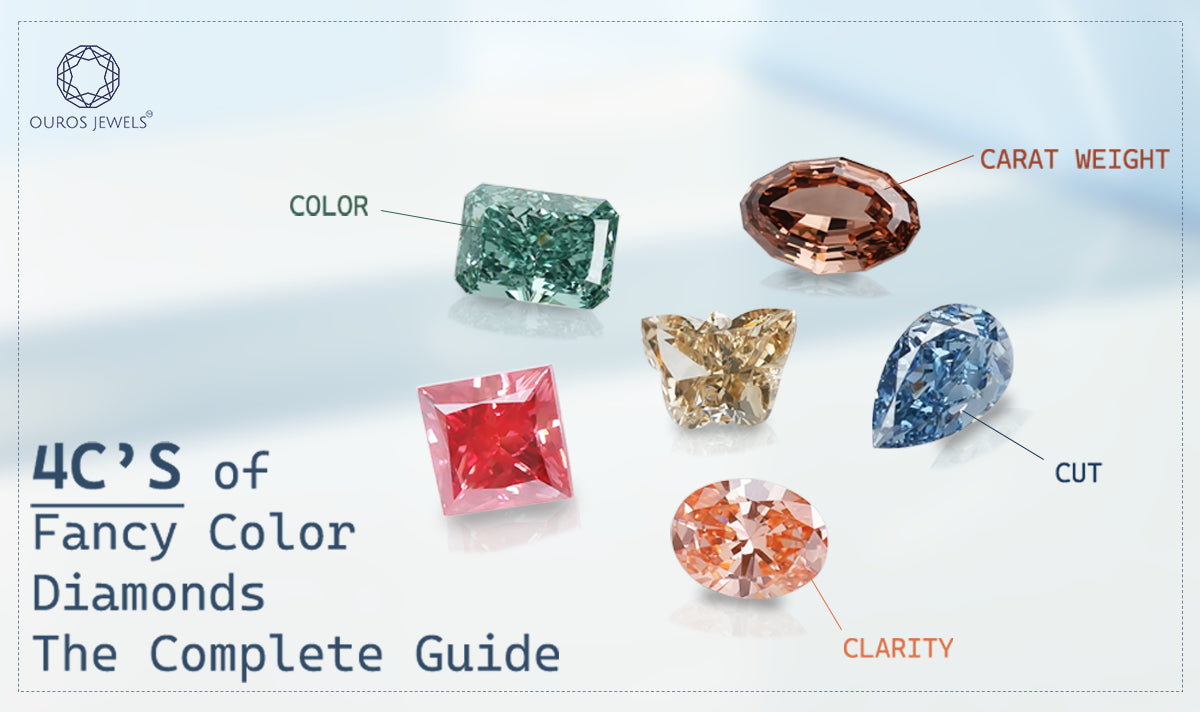
4Cs of Fancy Colour Diamonds: The Complete Guide

Fancy colour diamonds are evaluated using several important quality characteristics that help buyers understand their appearance, rarity and potential value. The traditional 4Cs of diamonds are colour, clarity, carat weight and cut. Together, these characteristics provide a useful framework for understanding a diamond fundamental qualities.
When selecting diamond jewellery, the aim is usually to find a high quality diamond that offers the desired appearance and value. The traditional 4Cs colour, clarity, carat weight and cut are important, alongside factors such as polish, symmetry and fluorescence. However, their relative importance can differ depending on whether you are choosing a colourless diamond or a fancy colour diamond.
Fancy colour diamonds require particular attention to their colour because hue, tone and saturation can have a significant influence on their appearance and value. GIA coloured diamond grading system evaluates these characteristics separately from the traditional D-to Z colour scale used for colourless and near colourless diamonds.
There are broadly two categories of diamonds: colourless or near colourless diamonds and fancy colour diamonds. Both can be evaluated for characteristics such as clarity, carat weight and craftsmanship, but their colour is assessed differently.
For example, colourless and near-colourless diamonds are commonly assessed using the GIA D-to-Z colour scale, while fancy colour diamonds fall outside the normal D to Z range and are evaluated using a specialised system that considers hue, tone and saturation.
In this guide, you will learn about the 4Cs of fancy colour diamonds and how these characteristics can help when choosing coloured diamond jewellery. Lab grown diamonds have essentially the same chemical composition and crystal structure as natural diamonds, although their growth environments and origins differ.
First, let's understand how colour is introduced into fancy colour lab-grown diamonds.
How Are Fancy Colour Lab Grown Diamonds Made?
Fancy colour lab grown diamonds are produced using controlled laboratory growth processes, primarily Chemical Vapour Deposition (CVD) or High Pressure High Temperature (HPHT). The colour can be influenced by the presence of specific impurity elements, defects in the crystal structure, treatments or combinations of these factors.
For example, nitrogen can contribute to yellow or yellow-orange colour, while boron can contribute to blue colour in diamonds. GIA research also notes that the colour characteristics of laboratory grown diamonds can vary according to the growth method and the impurities or defects present within the crystal.
Yellow Lab Grown Diamonds
Nitrogen can play an important role in producing yellow or yellow-orange colour in laboratory grown diamonds. The concentration and distribution of nitrogen within the diamond can influence the resulting colour.
Chocolate and Champagne Diamonds
Brown, champagne and chocolate coloured diamonds can result from structural features and defects within the diamond. Their final appearance depends on the way the crystal forms and any subsequent treatment or processing.
Olive Coloured Diamonds
Olive or greenish brown appearances can result from combinations of colour-causing characteristics. The exact cause depends on the diamond growth conditions, impurities and treatments, so the colour should be evaluated individually rather than attributed to one element alone.
Blue Lab Grown Diamonds
Boron is associated with blue colour in diamonds. In laboratory-grown diamonds, boron can be incorporated into the crystal during growth and influence the resulting blue appearance.
Red Lab Grown Diamonds
Red diamonds are exceptionally unusual. A red appearance can be associated with structural defects and colour centres, and laboratory-grown red diamonds may also involve specific growth conditions or treatments. Therefore, it is important not to assume that one particular element alone creates every red laboratory-grown diamond.
For buyers, the key point is that the origin and treatment of a fancy colour diamond should be verified through an appropriate grading report when this information is important to the purchase.
Why Are the 4Cs Important in Fancy Colour Diamonds?
The 4Cs colour, clarity, carat weight and cut provide a useful framework for evaluating a diamond's quality and appearance. However, fancy colour diamonds differ from colourless diamonds because colour can become the most important value factor.
For fancy colour diamonds, the strength and character of the colour can have a major effect on desirability and price. GIA evaluates fancy colours according to hue, tone and saturation, with terms such as Fancy Light, Fancy, Fancy Intense, Fancy Deep and Fancy Vivid used to describe different colour appearances.
For example, two 1 carat fancy blue diamonds can have very different values if one has a more attractive or saturated colour than the other, even when their clarity and carat weight are similar.
This is why looking at the 4Cs together is more useful than judging a fancy colour diamond by a single characteristic.
The 4Cs of Fancy Colour Diamonds
The traditional 4Cs of diamonds are clarity, cut, carat weight and colour. For fancy colour diamonds, however, colour deserves particular attention because its hue, tone and saturation can strongly influence appearance and rarity.
Let's look at each characteristic and understand how it applies to fancy colour diamonds.
The Clarity Grade of Fancy Colour Diamonds
![[Clarity chart in fancy color diamond]-[ouros jewels]](https://cdn.shopify.com/s/files/1/0527/7669/8040/files/Fancy_Color_Diamonds_Clarity_Chart_480x480.webp?v=1686559872)
Clarity describes the presence, size, position and visibility of inclusions and blemishes in a diamond. The GIA clarity scale contains 11 grades, ranging from Flawless (FL) to Included (I3).
The clarity grades are:
- FL = Flawless
- IF = Internally Flawless
- VVS1 = Very, Very Slightly Included 1
- VVS2 = Very, Very Slightly Included 2
- VS1 = Very Slightly Included 1
- VS2 = Very Slightly Included 2
- SI1 = Slightly Included 1
- SI2 = Slightly Included 2
- I1 = Included 1
- I2 = Included 2
- I3 = Included 3
For fancy colour diamonds, clarity does not always carry the same weight as it does for colourless diamonds. Colour is generally the dominant value factor, meaning a fancy colour diamond with lower clarity can still be highly desirable if it displays attractive colour. However, inclusions that affect transparency, appearance or durability can reduce a diamond's desirability and value.
Therefore, choosing the highest possible clarity grade is not always necessary for a fancy colour diamond. The right balance depends on the colour, size, shape and intended jewellery design.
Fancy Colour Diamond Cut
![[Cut chart in colored diamonds]-[ouros jewels]](https://cdn.shopify.com/s/files/1/0527/7669/8040/files/Colored_Diamonds_Cut_Chart_480x480.webp?v=1686559964)
Cut affects how a diamond interacts with light and can influence its face-up appearance. However, it is important to distinguish between cut quality and cut grade.
A standard GIA cut grade from Excellent to Poor is specifically applied to standard round brilliant diamonds in the D-to-Z colour range. Fancy shapes such as pear, oval, emerald, radiant and cushion do not receive the same standardised GIA cut grade.
For fancy colour diamonds, the shape and proportions can also influence how the colour appears. GIA notes that larger size, deeper pavilions and certain cutting styles can sometimes help create a richer face-up colour.
This makes shape an important consideration when choosing a fancy colour diamond.
Popular shapes include:
- Round
- Oval
- Pear
- Cushion
- Radiant
- Emerald
- Princess
- Heart
The best choice depends on the desired colour appearance, jewellery design and personal preference.
Colour Grade in Fancy Colour Diamonds
![[Color diamonds chart]-[ouros jewels]](https://cdn.shopify.com/s/files/1/0527/7669/8040/files/Fancy_Color_Diamonds_Chart_480x480.webp?v=1686560042)
Colour is often the most important consideration when evaluating a fancy colour diamond.
Unlike colourless diamonds, which are generally graded using the D-to-Z scale, fancy colour diamonds are evaluated according to hue, tone and saturation.
- Hue describes the dominant colour, such as blue, pink, yellow or green.
- Tone describes how light or dark the colour appears.
- Saturation describes the strength or intensity of the colour.
GIA uses descriptions such as:
- Fancy Light
- Fancy
- Fancy Dark
- Fancy Deep
- Fancy Intense
- Fancy Vivid
The exact grade depends on the diamond's individual colour characteristics.
Fancy colour diamonds can occur in many hues, including yellow, pink, blue, green, orange, red, brown and combinations of these colours. Saturated pink, blue and green diamonds are among the particularly rare and valuable fancy colours. Red diamonds are also exceptionally rare.
This is why colour should be considered carefully when selecting a fancy colour diamond.
Carat Weight for Fancy Colour Diamonds
![[Carat weight chart for fancy color diamonds]-[ouros jewels]](https://cdn.shopify.com/s/files/1/0527/7669/8040/files/Fancy_Color_Diamonds_Carat_Weight_Chart_480x480.webp?v=1686560218)
Carat weight measures a diamond's weight rather than its physical dimensions. One carat equals 0.2 grams, so a 1-carat diamond weighs 0.20 grams.
There is no separate carat-weight system for coloured and colourless diamonds. The same measurement applies to both.
Fancy colour diamonds are available in a wide range of carat weights. Larger fancy colour diamonds can be particularly rare, and carat weight can therefore contribute significantly to their value.
The ideal carat weight depends on the jewellery design, budget, diamond shape and desired visual presence. Rather than assuming that a particular range such as 1 to 3 carats is always the best choice, buyers should consider how the diamond's size works with its colour and proportions.
For example, a buyer considering a 1 carat yellow diamond ring can choose a smaller centre stone for a subtle appearance, while a 3 carat blue colour diamond ring can create a more prominent look.
The right carat weight ultimately depends on the wearer's preference and the proportions of the finished jewellery.
Colour Wise Diamond Clarity Selection
Clarity should be considered alongside the colour, size and overall appearance of a fancy colour diamond.
Because colour can be the dominant value factor in fancy colour diamonds, buyers do not necessarily need to select the highest clarity grade available. Instead, it can be more useful to choose a clarity grade that provides an attractive face-up appearance without paying unnecessarily for clarity characteristics that are not visible to the unaided eye.
Here is a general guide:
Orange Colour Diamond
A VS clarity diamond can offer a practical balance between clarity and value, provided the inclusions do not affect the diamond's appearance or durability.
Blue Colour Diamond
VVS or VS clarity may be preferred by buyers who want fewer visible inclusions. However, the intensity and quality of the blue colour should also be considered because colour is a major factor in fancy colour diamond value.
Pink Colour Diamond
VVS or VS clarity can be attractive choices for pink diamond jewellery, particularly when the diamond is large enough for inclusions to be more noticeable. However, the colour grade should generally be assessed alongside clarity rather than treating clarity as the only priority.
Yellow Colour Diamond
VS clarity can provide a good balance for many yellow fancy colour diamonds. The strength and attractiveness of the yellow colour should be considered before paying a premium for higher clarity.
Red Colour Diamond
Red diamonds are exceptionally rare, so their colour characteristics can be particularly important. VVS or VS clarity may be desirable, but the overall colour, rarity and presence of any durability-affecting inclusions should also be considered.
The important point is that there is no single clarity grade that is automatically best for every fancy colour diamond. The appropriate choice depends on the individual stone and how its colour and inclusions interact visually.
In Which Jewellery Are Fancy Colour Diamonds Used?
![[Fancy color lab diamond engagement ring]-[ouros jewels]](https://cdn.shopify.com/s/files/1/0527/7669/8040/files/Blog-4cs_Of_Fancy_Color_Diamonds-Engagement_Ring-Ouros_Jewels_480x480.webp?v=1684730960)
Fancy colour diamonds can be used in many types of jewellery, including engagement rings, wedding bands, bracelets, necklaces, earrings and bangles.
Their distinctive colours allow buyers to create jewellery with a more individual appearance while choosing a diamond based on personal style.
Common jewellery options include:
- Engagement rings
- Wedding bands
- Earrings
- Bangles
- Bracelets
- Necklaces
You can choose a fancy colour lab-grown diamond based on the recipient's preferences, jewellery style and occasion. When selecting coloured diamond jewellery, also consider the metal, carat weight, diamond shape, setting design and overall budget.
For example, yellow and orange diamonds can work well with yellow gold, while pink diamonds can complement rose gold. White gold and platinum can provide contrast against many fancy colours.
Fancy Colour Diamond Jewellery Price Guide
|
Fancy Colour Diamond Jewellery |
Typical Carat Weights |
Popular Designs |
Common Metal Choices |
Indicative Price Range |
|
Engagement Rings |
1–5 ct |
Halo, Solitaire, Three-Stone, Pavé |
14K/18K White or Yellow Gold |
$1,000–$5,000 |
|
Wedding Bands |
1–8 ct |
Eternity, Channel, Five-Stone |
18K Rose Gold or Platinum |
$800–$8,000 |
|
Necklaces |
10–25 ct total |
Tennis, Choker |
18K Yellow Gold or Platinum |
$2,500–$25,000 |
|
Bracelets |
4–10 ct total |
Tennis, Charm |
14K Rose or Yellow Gold |
$2,000–$8,500 |
|
Earrings |
1–4 ct total |
Stud, Hoop, Drop, Dangle |
18K Yellow or Rose Gold |
$500–$7,000 |
|
Bangles |
10–18 ct total |
Pavé, Flush Set |
18K White Gold |
$3,000–$15,000 |
These are indicative figures rather than fixed prices. The final price of fancy colour lab-grown diamond jewellery can vary according to colour grade, clarity, carat weight, cut and shape, metal, jewellery design, certification and current market conditions.
Therefore, buyers should use the table as a general guide rather than a guaranteed price list.
Conclusion
Understanding the 4Cs can make it easier to evaluate fancy colour diamonds and choose jewellery that suits your preferences.
However, fancy colour diamonds should not be assessed in exactly the same way as colourless diamonds. Colour is particularly important, and hue, tone and saturation can have a major influence on the diamond's appearance, rarity and value. Clarity, carat weight and cut or proportions should then be considered alongside colour to understand the complete picture.
When buying a fancy colour diamond ring, necklace, bracelet, bangle or another piece of jewellery, consider the diamond's grading report, colour characteristics, clarity, carat weight, shape and overall craftsmanship.
For customised fancy colour diamond jewellery, an appropriate grading report can also provide useful information about the diamond's characteristics and, where applicable, its origin and treatment.
FAQs
Q1. Which colour suits fancy diamonds best?
There is no single best colour because the choice depends on personal preference. Popular fancy colours include pink, blue, yellow, green and red. Their desirability can also depend on hue, tone and saturation.
Q2. What are the 4Cs of a diamond?
The 4Cs are colour, clarity, cut and carat weight. Together, they describe key characteristics of a diamond and help buyers and jewellery professionals evaluate its quality and value.
Q3. What are the grades of fancy colour diamonds?
Fancy colour diamonds are described using terms based on their colour strength, including Fancy Light, Fancy, Fancy Dark, Fancy Deep, Fancy Intense and Fancy Vivid. The grading considers the diamond's hue, tone and saturation.
Q4. What is the rarest fancy diamond colour?
Red diamonds are among the rarest fancy colour diamonds, while saturated pink, blue and green diamonds are also exceptionally rare and highly valued. Rarity and value depend on the individual diamond's colour characteristics and other quality factors.
Q5. What is the most attractive diamond colour?
Beauty is subjective, so there is no universally most attractive diamond colour. Colourless diamonds are valued for their bright, neutral appearance, while pink, blue, yellow, green and other fancy colours appeal to buyers looking for a distinctive appearance.
Q6. Do fancy colour diamonds make a good investment?
Fancy colour diamonds can be rare and highly valuable, but they should not automatically be treated as guaranteed investments. Their value can depend on colour rarity, saturation, size, clarity, origin, treatment, certification, market demand and other factors.
If you are considering a fancy colour diamond as an investment, independent research and advice from a qualified gemmologist or appropriate financial professional can be useful.
Q7. Are lab grown fancy colour diamonds real diamonds?
Yes. Lab-grown diamonds are diamonds produced through controlled technological processes rather than geological formation underground. They have the same basic carbon crystal structure as natural diamonds, although their growth environment and origin are different. Laboratory-grown diamonds can also display different colour characteristics depending on their growth conditions, impurities and treatments.
Q8. Are fancy colour diamonds graded differently from colourless diamonds?
Yes. Colourless and near-colourless diamonds are generally assessed using the D-to-Z colour scale, whereas fancy colour diamonds are evaluated using a specialised system based on hue, tone and saturation.
Q9. Does clarity matter in fancy colour diamonds?
Yes, but its importance can differ from that of colourless diamonds. In fancy colour diamonds, attractive colour can be the dominant value factor. However, inclusions that affect transparency, appearance or durability can still reduce desirability and value.
Q10. What should I check before buying a fancy colour diamond?
Check the diamond's colour characteristics, grading report, carat weight, clarity, shape, proportions, treatment or origin information where available, and the overall jewellery design. Comparing these factors together gives a more reliable understanding of the diamond than focusing on a single grade.


